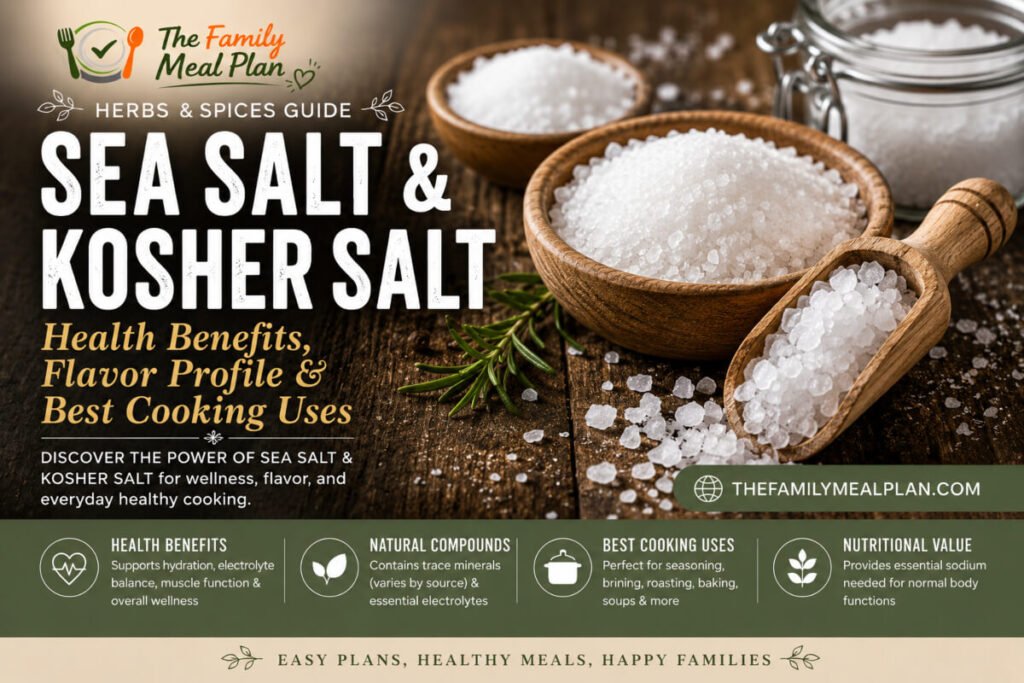
Sea Salt & Kosher Salt
Few ingredients have shaped human civilization, food preservation, culinary traditions, and daily cooking habits more than salt. Long before refrigeration existed, salt was valued for its ability to preserve food, support fermentation, enhance flavor, and help sustain communities around the world. Today, sea salt and kosher salt remain two of the most widely used ingredients in healthy home cooking because they contribute both essential physiological functions and exceptional culinary versatility.
Unlike herbs and spices that are primarily valued for plant compounds, salt is fundamentally different. Sodium, the primary mineral found in salt, is an essential electrolyte required for normal fluid balance, nerve signaling, muscle contraction, hydration regulation, and many other physiological processes that support everyday health. Because the human body cannot produce sodium on its own, it must be obtained through food.
Sea salt is typically produced through the natural evaporation of seawater, while kosher salt is commonly sourced from underground salt deposits and processed into larger, coarse crystals. Although both consist primarily of sodium chloride, differences in crystal structure, texture, harvesting methods, and culinary performance have made each a favorite for different cooking applications. Sea salt is often appreciated for its naturally occurring trace minerals and finishing qualities, while kosher salt has become the preferred seasoning salt among many professional chefs because of its ease of handling and precise control during cooking.
Researchers continue studying sodium’s role in hydration, electrolyte balance, exercise performance, nerve communication, and overall physiological function. At the same time, health organizations emphasize the importance of moderation because excessive sodium intake may contribute to elevated blood pressure in some individuals. Understanding how to use salt appropriately is one of the most important skills in creating flavorful, balanced meals.
Throughout Mediterranean, European, Asian, Middle Eastern, African, and American food cultures, salt has long served as both a practical necessity and a culinary foundation. From preserving meats and vegetables to seasoning soups, roasted vegetables, proteins, grains, and homemade meals, sea salt and kosher salt remain indispensable ingredients in healthy kitchens around the world.
Today, sea salt and kosher salt continue to play a central role in meal preparation, family dinners, food preservation, fermentation practices, and flavor-focused cooking because they provide one of the most important building blocks in the entire culinary world.
Sea Salt & Kosher Salt: More Than Just a Seasoning
Walk into virtually any kitchen and you will find some form of salt sitting nearby.
Because it is so common, most people rarely stop to think about it.
Yet few ingredients have influenced human history, nutrition, agriculture, trade, preservation methods, and culinary development as much as salt.
Unlike many ingredients that are valued primarily for flavor, salt serves multiple purposes simultaneously. It enhances taste, influences texture, supports food preservation, contributes to fermentation, and provides sodium—an essential electrolyte required for normal physiological function.
For thousands of years, civilizations built trade routes around salt. Entire economies developed because of its value. Long before refrigeration existed, salt helped preserve food supplies and made long-distance travel possible. Even today, many traditional food cultures continue to rely on salting techniques developed centuries ago.
Modern nutrition discussions surrounding salt often focus on sodium intake and cardiovascular health. While moderation remains important, it is equally important to recognize that sodium performs critical functions within the body. Proper fluid balance, nerve communication, and muscle contraction all depend on adequate electrolyte regulation.
At the same time, salt remains one of the most powerful tools available to home cooks. Proper seasoning can transform vegetables, proteins, soups, sauces, grains, and legumes while helping natural flavors shine without relying on highly processed flavor enhancers.
Understanding sea salt and kosher salt goes beyond learning when to season food. It means understanding why one of humanity’s oldest ingredients remains one of the most important foundations of healthy, flavor-focused home cooking today.
💡 Building flavorful homemade meals often starts with mastering foundational ingredients. Few ingredients influence flavor, texture, cooking performance, and overall meal satisfaction more than salt. Learning how to use sea salt and kosher salt properly can dramatically improve everyday cooking.
Why Sea Salt & Kosher Salt Matter in Healthy Cooking
Sea salt and kosher salt sit at the intersection of nutrition, culinary science, food preservation, and practical home cooking.
While many ingredients contribute either flavor or nutrition, salt contributes to both physiological function and culinary performance. Sodium is an essential electrolyte required for life, while salt itself remains one of the most effective tools for enhancing natural food flavors.
Understanding sea salt and kosher salt’s role in hydration, electrolyte balance, nerve function, muscle contraction, flavor development, fermentation, preservation, and cooking applications can help home cooks make more informed ingredient choices while creating healthier meals built around whole foods and simple pantry staples.
This is one reason sea salt and kosher salt appear so frequently throughout our:
● Meal Prep Recipes & Planning
● Mediterranean-inspired meals
● Roasted vegetable recipes
● Homemade seasoning blends
● Protein-focused recipes
● Soup and stew recipes
● Practical family cooking guides
Whether your goal is improving cooking skills, understanding nutrition, building more flavor naturally, or creating healthier homemade meals, salt remains one of the most valuable ingredients to understand and use correctly.
Quick Health Benefit Highlights
Sea salt and kosher salt are commonly associated with:
● Providing sodium, an essential electrolyte required for life
● Supporting fluid balance and hydration regulation
● Supporting normal nerve signaling and communication
● Helping regulate muscle contraction and movement
● Maintaining electrolyte balance throughout the body
● Supporting normal physiological function during physical activity
● Contributing to food preservation and fermentation traditions
● Enhancing natural food flavor without added sugars or artificial flavorings
● Supporting ingredient-focused whole-food cooking
● Providing trace minerals depending on source and processing methods
● Serving as one of the most important culinary ingredients in global food traditions
● Supporting balanced home cooking when used in moderation
💡 Unlike garlic, onion powder, and black pepper, salt’s wellness value comes primarily from its role as an essential electrolyte rather than from plant compounds. Understanding this distinction is important when evaluating health claims surrounding different salt varieties.
Save This Sea Salt & Kosher Salt Guide for Later
Before exploring Sea Salt & Kosher Salt: Health Benefits & Cooking Uses, save this reference so you can quickly return to information about sea salt and kosher salt’s role in hydration, electrolyte balance, nerve function, muscle contraction, food preservation, culinary applications, harvesting methods, seasoning techniques, flavor development strategies, and practical ways to use salt in healthy homemade meals.
📌 Save this guide: Sea Salt & Kosher Salt: Health Benefits & Cooking Uses to Pinterest for later and revisit it whenever you need practical seasoning advice, sodium guidance, and cooking tips for everyday healthy meals.
Sea salt and kosher salt are far more than basic seasonings. From hydration and electrolyte balance to food preservation, fermentation, culinary science, and everyday cooking versatility, understanding how salt functions can help you create more flavorful and balanced meals while developing stronger foundational cooking skills.
💡 Beyond flavor enhancement, salt performs several essential physiological functions within the body. Understanding how sodium supports hydration, nerve signaling, muscle contraction, and overall fluid balance helps explain why salt has remained one of humanity’s most valuable food ingredients for thousands of years.
10+ Essential Physiological Functions & Wellness Roles Associated With Salt
Unlike herbs and spices that derive much of their wellness reputation from antioxidants and plant compounds, salt’s importance stems from its role as a source of sodium—an essential electrolyte required for normal physiological function.
While health organizations consistently recommend moderation, researchers also recognize that sodium performs numerous critical functions necessary for everyday health and survival.
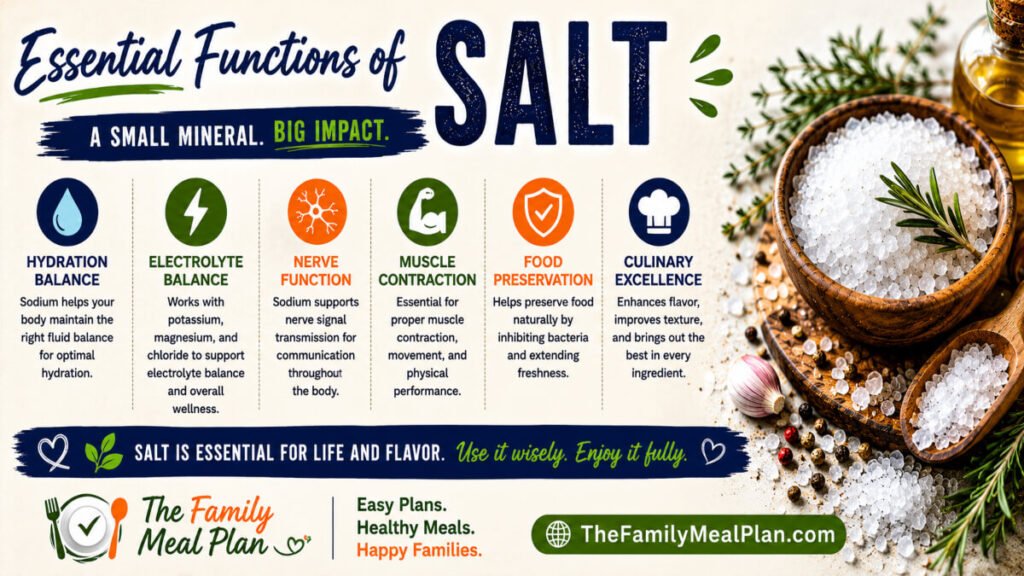
Some of the most commonly discussed physiological functions associated with sodium and salt include:
1. Supports Fluid Balance
One of sodium’s most important roles involves helping regulate the body’s fluid balance.
Water inside and outside cells must remain carefully balanced for tissues and organs to function properly. Sodium helps maintain this balance by regulating the movement of fluids throughout the body.
Proper fluid regulation supports:
● Cellular function
● Circulation
● Temperature regulation
● Nutrient transport
● Overall hydration status
Without adequate sodium, the body’s ability to manage fluid balance becomes impaired.
Because of this, sodium remains one of the body’s most essential electrolytes.
2. Supports Hydration Regulation
Hydration involves more than simply drinking water.
Electrolytes help the body absorb, retain, and utilize fluids effectively.
Sodium plays a central role in:
● Maintaining hydration
● Supporting fluid absorption
● Regulating water distribution
● Supporting exercise recovery
● Preventing electrolyte imbalances
This is one reason athletes, outdoor workers, and physically active individuals often pay close attention to electrolyte intake during prolonged activity.
Hydration discussions frequently focus on the relationship between water and electrolytes rather than water alone.
3. Supports Normal Nerve Signaling
Every thought, movement, and sensation depends upon communication between nerves.
Sodium plays a critical role in generating and transmitting nerve impulses throughout the body.
Normal nerve function supports:
● Muscle control
● Sensory awareness
● Cognitive processes
● Reflex responses
● Communication between organs and tissues
Because sodium is directly involved in these electrical signaling processes, it remains essential for healthy neurological function.
4. Supports Healthy Muscle Contraction
Muscles depend on electrolytes to contract and relax properly.
Sodium works alongside potassium, calcium, and magnesium to help regulate muscular activity.
This process influences:
● Everyday movement
● Exercise performance
● Physical activity
● Coordination
● Recovery after exertion
Without appropriate electrolyte balance, muscle performance may be affected.
This is one reason sodium remains an important component of overall nutritional health.
5. Supports Electrolyte Balance
Electrolytes function as a coordinated system throughout the body.
Sodium interacts with:
● Potassium
● Magnesium
● Calcium
● Chloride
Together, these minerals help regulate:
● Hydration
● Nerve function
● Muscle activity
● Cellular communication
● Physiological stability
Maintaining balanced electrolyte intake remains one of the fundamental principles of healthy nutrition.
6. Supports Physical Activity & Exercise Performance
During exercise, the body loses both water and electrolytes through perspiration.
Researchers continue studying the relationship between sodium intake, hydration, and athletic performance.
Sodium may help support:
● Endurance activity
● Exercise recovery
● Fluid retention during prolonged activity
● Electrolyte replacement
● Heat tolerance
This relationship explains why sodium often appears in sports beverages and hydration products designed for extended physical activity.
7. Supports Nutrient Transport
Sodium helps facilitate the movement of nutrients across cellular membranes.
This process plays a role in transporting:
● Glucose
● Amino acids
● Water
● Various nutrients
throughout the body.
While this function often receives less public attention, it remains one of sodium’s most important physiological responsibilities.
8. Supports Healthy Circulation
Proper fluid balance contributes to healthy circulation.
Because sodium influences fluid regulation, researchers continue studying its role in cardiovascular physiology.
This area requires balance.
Too little sodium can create challenges.
Excessive sodium intake may also create concerns for certain individuals.
Understanding appropriate sodium consumption remains an important part of cardiovascular wellness discussions.
9. Supports Food Preservation & Food Safety
One of salt’s oldest and most valuable contributions involves food preservation.
For centuries, salt has been used to:
● Preserve meats
● Cure fish
● Extend shelf life
● Support fermentation
● Improve food safety
Long before refrigeration existed, salt helped communities store food for extended periods.
Many traditional food preservation methods continue to rely on salt today.
10. Supports Fermentation Traditions
Many beneficial fermented foods depend upon salt.
Examples include:
● Sauerkraut
● Kimchi
● Pickled vegetables
● Fermented condiments
Salt helps create an environment that supports desirable fermentation organisms while limiting unwanted microbial growth.
This role has helped establish salt as one of the foundational ingredients in traditional food cultures throughout the world.
11. Enhances Flavor & Supports Healthy Home Cooking
One of salt’s most practical benefits may simply be its ability to improve the flavor of nutritious foods.
Proper seasoning can make:
● Vegetables
● Legumes
● Whole grains
● Lean proteins
● Soups
● Homemade meals
more enjoyable and satisfying.
For many families, better flavor encourages greater consumption of nutrient-dense foods.
This makes salt one of the most powerful culinary tools available to home cooks.
12. Supports Sustainable Whole-Food Eating Habits
Healthy eating patterns are easier to maintain when meals taste good.
Sea salt and kosher salt help build flavor naturally while allowing cooks to emphasize:
● Fresh ingredients
● Vegetables
● Herbs and spices
● Lean proteins
● Whole-food cooking
This practical role is often overlooked but remains one of the primary reasons salt continues to be indispensable in healthy home kitchens.
💡 While sodium is essential for hydration, nerve function, muscle contraction, and electrolyte balance, health experts consistently emphasize moderation. The goal is not eliminating salt entirely but understanding how to use it appropriately within a balanced dietary pattern built around nutrient-dense whole foods.
Naturally Occurring Minerals in Sea Salt & Kosher Salt
Unlike garlic, onion powder, and black pepper, which are valued largely for naturally occurring plant compounds, sea salt and kosher salt derive their importance from their mineral composition.
The primary component of both sea salt and kosher salt is sodium chloride, a mineral compound consisting of sodium and chloride. Together, these minerals function as essential electrolytes that help regulate fluid balance, nerve communication, muscle contraction, and numerous physiological processes throughout the body.
While all culinary salts provide sodium chloride, differences in harvesting methods, processing techniques, and crystal structures can influence trace mineral content, flavor characteristics, texture, and cooking performance.
Among the most commonly discussed minerals found in sea salt and kosher salt are:
Sodium
Sodium is the primary mineral found in all culinary salts.
Researchers recognize sodium as an essential electrolyte involved in:
● Fluid balance
● Hydration regulation
● Nerve signaling
● Muscle contraction
● Nutrient transport
● Blood volume regulation
Because sodium is required for life, it must be obtained through dietary intake.
Much of salt’s physiological importance originates from sodium’s role throughout the body.
Chloride
While sodium often receives most of the attention, chloride is equally important.
Chloride helps support:
● Fluid balance
● Electrolyte regulation
● Digestive processes
● Stomach acid production
● Nutrient absorption
Together, sodium and chloride form sodium chloride—the compound commonly recognized as salt.
Trace Minerals Found in Some Sea Salts
Depending on harvesting location and production methods, some sea salts may contain small amounts of naturally occurring minerals such as:
● Magnesium
● Potassium
● Calcium
● Zinc
● Iron
● Manganese
These minerals contribute to subtle differences in color, flavor, and texture.
However, most nutrition experts emphasize that the quantities are typically quite small and should not be viewed as significant nutritional sources.
Their primary contribution is often culinary rather than nutritional.
Why Trace Minerals Receive Attention
Many sea salt marketing claims focus heavily on trace mineral content.
While these minerals do exist, research consistently shows that the amounts present are generally minimal compared to vegetables, fruits, legumes, nuts, seeds, and other nutrient-dense foods.
The true value of sea salt lies less in its trace minerals and more in:
● Flavor
● Texture
● Culinary versatility
● Harvesting traditions
● Crystal structure
● Cooking performance
Understanding this distinction helps consumers make more informed decisions when comparing different salt varieties.
💡 Unlike garlic’s allicin, black pepper’s piperine, or onion powder’s quercetin, salt’s nutritional importance comes primarily from sodium and chloride—two essential electrolytes required for normal physiological function.
Understanding Sodium: Why the Body Needs It
Few nutrients create more confusion than sodium.
Public discussions often focus on reducing sodium intake, yet sodium itself remains essential for life.
The reality is more balanced.
The body requires sodium to perform numerous critical functions, but excessive intake may present concerns for certain individuals.
Researchers recognize sodium’s involvement in:
● Hydration regulation
● Nerve communication
● Muscle contraction
● Blood volume maintenance
● Nutrient transport
● Electrolyte balance
This dual reality explains why health organizations encourage moderation rather than complete elimination.
Too little sodium can create problems.
Too much sodium may also create challenges.
The goal is balance.
Healthy eating patterns focus on appropriate sodium intake within a diet built around vegetables, fruits, legumes, whole grains, lean proteins, and minimally processed foods.
Sea Salt vs Kosher Salt vs Table Salt
One of the most common questions surrounding salt involves the differences between various types. While all three salts contain sodium chloride as their primary component, important differences exist in crystal size, texture, mineral content, processing methods, and culinary performance.
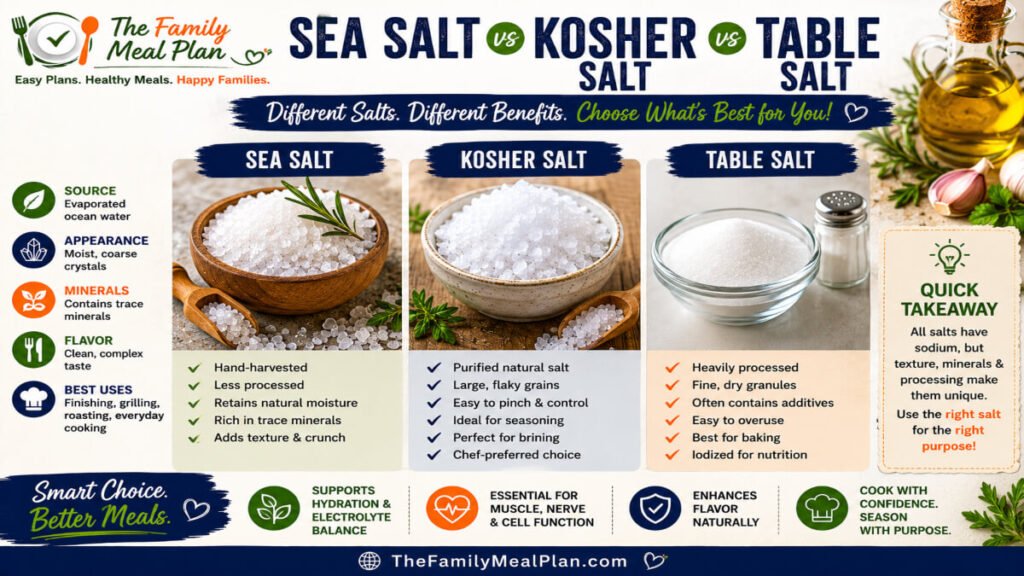
Although sea salt, kosher salt, and table salt all consist primarily of sodium chloride, several important distinctions exist.
| Feature | Sea Salt | Kosher Salt | Table Salt |
|---|---|---|---|
| Primary Source | Evaporated seawater | Mined salt deposits | Mined salt deposits |
| Crystal Size | Variable | Large coarse flakes | Fine crystals |
| Texture | Crisp, flaky, coarse | Easy to pinch and distribute | Fine and compact |
| Trace Minerals | May contain small amounts | Minimal | Usually removed during refining |
| Common Use | Finishing salt | Everyday cooking | Table seasoning |
| Chef Preference | Finishing applications | Most preferred cooking salt | Less common in professional kitchens |
The nutritional differences between these salts are generally much smaller than many consumers assume.
The biggest distinctions involve:
● Crystal size
● Texture
● Flavor perception
● Ease of seasoning
● Cooking performance
Why Chefs Prefer Kosher Salt
Professional chefs frequently choose kosher salt over other varieties.
The reason is rarely nutrition.
The reason is control.
While sea salt and kosher salt share many similarities, kosher salt has earned a special reputation among professional chefs due to its texture, consistency, and ease of handling during food preparation.
💡 Many professional chefs consider kosher salt the gold standard for seasoning. Its larger crystal structure provides greater control, more even distribution, and consistent results across a wide variety of cooking methods.
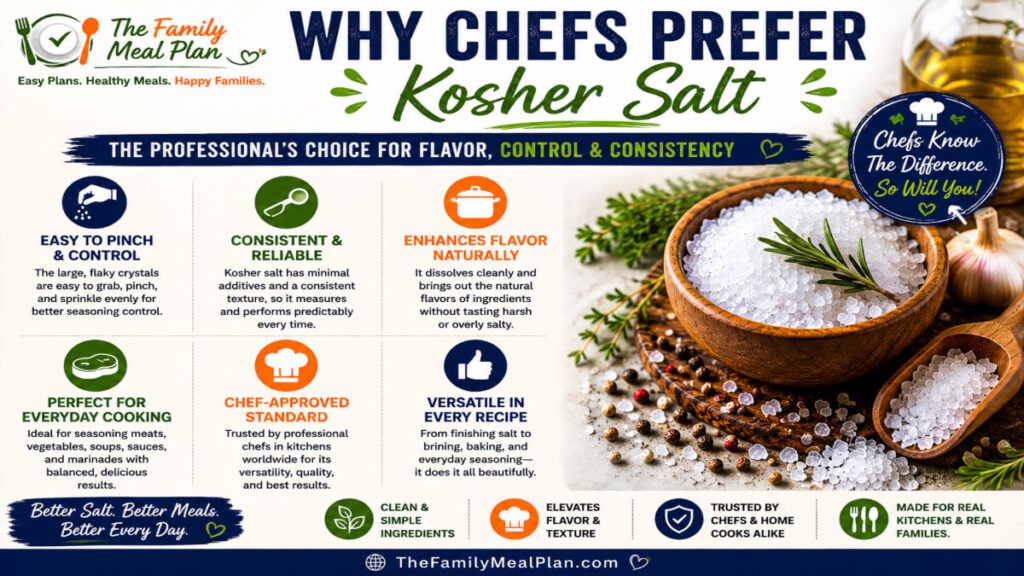
Kosher salt’s larger crystal structure allows cooks to:
● Pick up salt easily with their fingers
● Distribute seasoning more evenly
● See seasoning more clearly
● Control salt levels more accurately
● Reduce the risk of oversalting
Because of this precision, kosher salt has become the standard seasoning salt throughout many professional kitchens.
Its clean flavor and predictable performance make it ideal for:
● Proteins
● Vegetables
● Soups
● Sauces
● Marinades
● Everyday cooking
Why Sea Salt Remains Popular
Sea salt has become increasingly popular because of its texture, harvesting traditions, and finishing capabilities.
Many varieties are harvested using natural evaporation methods that have been practiced for centuries.
Sea salt is often used as a finishing salt because its crystals can provide:
● Visual appeal
● Texture contrast
● Enhanced flavor perception
● Crunch
● Specialty culinary applications
Flaky sea salts are especially valued on:
● Roasted vegetables
● Grilled meats
● Seafood
● Artisan breads
● Salads
● Finished dishes
When used properly, sea salt contributes both flavor and texture.
How Sea Salt Is Harvested
Sea salt production begins with seawater.
Traditional sea salt harvesting typically follows several stages:
Step 1: Seawater Collection
Seawater is directed into shallow evaporation ponds.
Step 2: Natural Evaporation
Sunlight and wind gradually remove water.
As moisture evaporates, salt concentrations increase.
Step 3: Crystal Formation
Salt crystals begin forming naturally as water levels decline.
Step 4: Harvesting
Workers collect salt crystals once optimal crystal development occurs.
Step 5: Drying & Packaging
The harvested salt is dried, sorted, and packaged for culinary use.
Many traditional sea salt operations continue using harvesting techniques that date back hundreds of years.
How Kosher Salt Is Produced
Kosher salt typically begins as mined salt extracted from underground deposits.
The production process generally includes:
Mining
Salt deposits are extracted from underground sources.
Purification
Impurities are removed.
Crystal Formation
Salt is processed into larger, coarser crystals.
Packaging
The finished salt is packaged for commercial and culinary use.
The resulting crystal structure differs significantly from standard table salt.
This difference helps explain its popularity among chefs.
Salt Crystal Structure & Cooking Science
One of the most overlooked aspects of salt involves crystal structure.
Two salts may contain nearly identical sodium content by weight, yet taste different when used in cooking.
This happens because crystal shape influences:
● Surface area
● Dissolving speed
● Flavor perception
● Texture
● Distribution across food
Larger crystals often provide slower dissolution and greater control.
Smaller crystals dissolve rapidly and can create concentrated bursts of salinity.
Understanding crystal structure helps explain why recipes often specify a particular type of salt.
Sea Salt & Kosher Salt Nutrition Facts
Although salt is not a significant source of calories, protein, carbohydrates, or vitamins, it remains nutritionally important because of its electrolyte content.
Approximate Nutrition (1 Teaspoon)
| Nutrient | Approximate Amount |
|---|---|
| Calories | 0 |
| Protein | 0g |
| Fat | 0g |
| Carbohydrates | 0g |
| Fiber | 0g |
| Sodium | ~2,000–2,400mg |
| Chloride | Present |
| Trace Minerals | Varies by source |
Values vary depending on crystal size and salt variety.
Common Salt Myths vs Reality
Myth:
Sea salt contains dramatically less sodium than table salt.
Reality:
By weight, sodium levels are very similar.
Myth:
Sea salt is a major source of minerals.
Reality:
Trace minerals exist but are generally present in small amounts.
Myth:
Kosher salt is healthier than other salts.
Reality:
Its primary advantage is culinary control rather than nutritional superiority.
Myth:
Healthy diets require eliminating salt entirely.
Reality:
Sodium is an essential nutrient. Most health guidance focuses on moderation, not elimination.
💡 Understanding how salt is harvested, processed, and used helps separate culinary facts from marketing claims. Sea salt and kosher salt earn their place in healthy kitchens not because they are miracle ingredients, but because they combine essential physiological functions with exceptional cooking performance.
Flavor Profile of Sea Salt & Kosher Salt
Although all culinary salts contain sodium chloride as their primary component, different salt varieties can create noticeably different experiences in cooking. Texture, crystal size, mineral content, harvesting methods, and how the salt dissolves on food all influence flavor perception.
Sea salt is often described as:
● Clean
● Bright
● Crisp
● Slightly mineral-forward
● Complex depending on origin
Some specialty sea salts may develop subtle flavor differences influenced by the waters from which they were harvested and the trace minerals they contain.
Kosher salt is often described as:
● Clean
● Pure
● Straightforward
● Balanced
● Easy to control
Because kosher salt contains larger crystals, it distributes evenly across food and allows cooks to season more precisely.
This combination of texture, control, and clean flavor explains why many chefs rely on kosher salt as their everyday cooking salt while reserving specialty sea salts for finishing dishes.
💡 Salt does far more than make food “taste salty.” Proper seasoning enhances natural flavors, balances bitterness, brightens ingredients, and helps create more satisfying meals without relying on highly processed flavor enhancers.
Best Cooking Uses for Sea Salt & Kosher Salt
Sea salt and kosher salt are among the most versatile ingredients found in healthy kitchens.
Kosher Salt Works Especially Well For:
● Seasoning meats and poultry
● Roasted vegetables
● Soups and stews
● Pasta water
● Marinades
● Homemade seasoning blends
● Everyday meal preparation
● Grilling and smoking
● Sheet pan dinners
● Meal prep recipes
Because of its crystal structure, kosher salt allows precise seasoning throughout the cooking process.
Sea Salt Works Especially Well For:
● Finishing roasted vegetables
● Seafood dishes
● Salads
● Artisan breads
● Mediterranean-inspired meals
● Grain bowls
● Grilled proteins
● Fresh vegetables
● Avocado dishes
● Specialty finishing applications
Many cooks use kosher salt while cooking and sea salt immediately before serving.
Best Foods to Pair with Salt
Few ingredients pair with as many foods as salt.
Sea salt and kosher salt naturally complement:
Proteins
● Chicken
● Turkey
● Beef
● Pork
● Seafood
● Fish
● Eggs
Vegetables
● Potatoes
● Broccoli
● Brussels sprouts
● Carrots
● Green beans
● Asparagus
● Cauliflower
Whole Grains & Legumes
● Rice
● Quinoa
● Farro
● Lentils
● Chickpeas
● Black beans
● White beans
Other Foods
● Soups
● Stews
● Sauces
● Homemade breads
● Pasta dishes
● Mediterranean-inspired recipes
● Healthy family dinners
Salt’s ability to complement virtually every food category is one reason it remains the foundation of successful cooking.
Best Herbs & Spices to Pair With Sea Salt & Kosher Salt
Salt rarely works alone.
Instead, it serves as the foundation that allows other herbs and spices to shine.
💡 Salt is often the ingredient that ties every seasoning together. Pairing sea salt and kosher salt with complementary herbs and spices helps create deeper flavor, better balance, and more satisfying homemade meals.
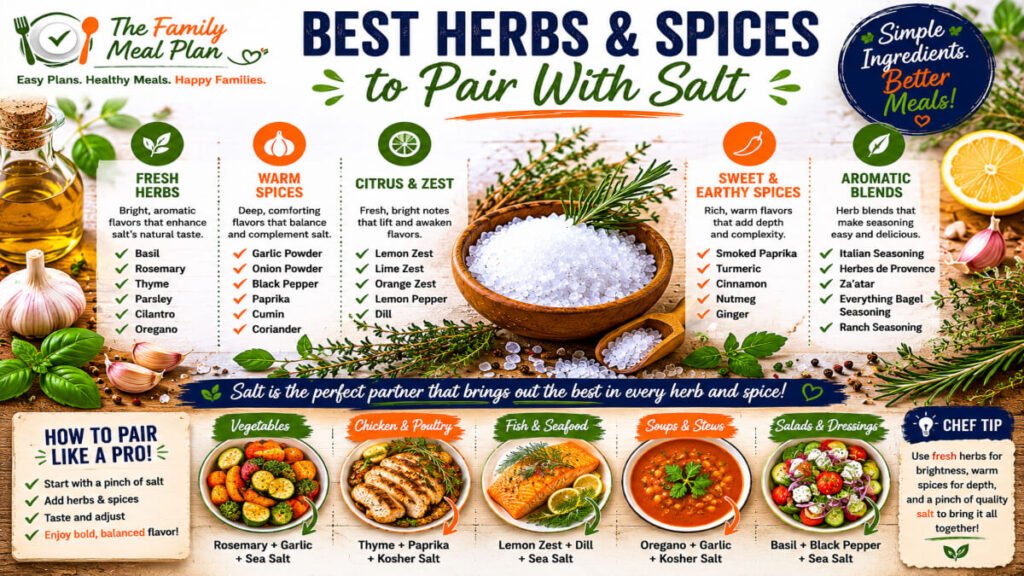
Some of the most popular seasonings commonly paired with sea salt and kosher salt include:
● Garlic
● Paprika
● Smoked Paprika
● Chili Powder
● Cumin
● Turmeric
● Cinnamon (for sweet applications)
● Rosemary
● Thyme
● Oregano
● Basil
● Parsley
● Dill
● Sage
● Coriander
● Cayenne Pepper
These combinations appear throughout our:
● Mediterranean-inspired meals
● Roasted vegetable recipes
● Homemade seasoning blends
● Meal Prep Recipes & Planning
💡 One reason salt remains indispensable is its ability to amplify the flavor of herbs and spices. Many seasonings become noticeably more vibrant when paired with appropriate amounts of salt.
How to Store Sea Salt & Kosher Salt
Salt is naturally shelf stable and one of the longest-lasting pantry ingredients available.
Proper storage helps maintain:
● Texture
● Crystal quality
● Flowability
● Flavor consistency
Storage Recommendations
Store salt:
● In airtight containers
● Away from moisture
● Away from direct sunlight
● Away from steam sources
● In cool, dry pantry locations
Excess moisture is the primary threat to salt quality because it can cause clumping and crystal breakdown.
When stored properly, sea salt and kosher salt can remain usable for many years.
Specialty Sea Salts
Flaky finishing salts should be protected carefully because moisture can damage their delicate crystal structure.
Many home cooks keep both kosher salt and finishing sea salt available because each serves different culinary purposes.
Potential Cooking Benefits
Sea salt and kosher salt remain two of the most practical ingredients in healthy home cooking because they help enhance natural flavors, improve seasoning consistency, and support a wide variety of cooking methods.
Some of their most valuable culinary benefits include:
● Enhances the natural flavors of meats, seafood, vegetables, and grains
● Helps create balanced seasoning throughout recipes
● Supports proper flavor development during cooking
● Works well in both simple and complex dishes
● Provides excellent control when seasoning proteins and vegetables
● Helps build homemade seasoning blends and dry rubs
● Supports brining, marinating, and food preparation techniques
● Essential for baking, roasting, grilling, and sautéing
● Contributes to traditional food preservation and fermentation methods
● Helps create more satisfying whole-food meals
● Widely used across Mediterranean, European, Asian, and global cuisines
● Remains one of the foundational ingredients in healthy home cooking
For many home cooks, sea salt and kosher salt serve as the starting point for building flavor. Whether preparing a quick weeknight dinner, meal prepping for the week ahead, or creating homemade seasoning blends, proper use of salt helps maximize the flavor of nearly every ingredient.
💡 Sea salt and kosher salt do far more than simply make food taste salty. When used properly, they help unlock natural flavors, improve balance, and create more satisfying meals from simple ingredients.
Recipes to Try with Sea Salt & Kosher Salt
One of the greatest strengths of sea salt and kosher salt is their ability to improve virtually every type of recipe. From proteins and vegetables to soups, sauces, grain bowls, and homemade seasoning blends, proper seasoning helps bring out the natural flavors of ingredients while creating more balanced and satisfying meals.
Because sea salt and kosher salt serve as foundational ingredients rather than specialty seasonings, they appear throughout many of our most popular healthy recipes, family dinners, meal prep ideas, and Mediterranean-inspired dishes.
If you’re looking for practical ways to improve your seasoning skills while creating more flavorful meals, these recipes are excellent places to start.
Easy Baked Lemon Herb Salmon with Vegetables
Proper seasoning is essential when preparing seafood, and sea salt helps enhance the salmon’s natural flavor while complementing the bright citrus notes, herbs, and roasted vegetables throughout the dish.
This recipe demonstrates how simple seasoning techniques can elevate healthy ingredients without overwhelming their natural characteristics.
Healthy Lemon Garlic Chicken
Sea salt and kosher salt work alongside garlic, lemon, and herbs to create a balanced flavor profile that enhances every component of this family-friendly meal.
The recipe highlights how proper seasoning can improve both proteins and vegetables while supporting simple, healthy home cooking.
Creamy Garlic Chicken Pasta
Seasoning is one of the keys to creating depth and balance in creamy pasta dishes.
Sea salt helps enhance the savory flavors of garlic, chicken, and Parmesan while bringing harmony to the rich sauce and tender pasta.
💡 Sea salt and kosher salt often work behind the scenes. Rather than becoming the star ingredient, they help unlock the natural flavors of the foods around them, making every ingredient taste more vibrant and balanced.
What foods pair best with Sea Salt and Kosher Salt?
Sea salt and kosher salt pair exceptionally well with:
● Seafood
● Poultry
● Beef
● Roasted vegetables
● Potatoes
● Grain bowls
● Soups
● Sauces
● Homemade seasoning blends
● Mediterranean-inspired dishes
Their versatility is one reason they remain foundational ingredients in kitchens around the world.
Frequently Asked Questions
Is sea salt healthier than table salt?
Sea salt and table salt both consist primarily of sodium chloride. While sea salt may contain small amounts of naturally occurring trace minerals depending on its source, health organizations generally consider both salts similar from a sodium perspective.
Is kosher salt healthier than table salt?
Kosher salt contains sodium just like table salt. Its primary differences involve crystal size, texture, and culinary performance rather than major nutritional differences.
Does sea salt contain minerals?
Some varieties of sea salt contain small amounts of naturally occurring trace minerals that remain after seawater evaporation. The amounts vary depending on the source and production method.
Why do chefs prefer kosher salt?
Many chefs prefer kosher salt because its larger crystal size makes it easier to pinch, distribute evenly, and control during seasoning.
Does sea salt contain sodium?
Yes. Sea salt consists primarily of sodium chloride and serves as a significant dietary source of sodium.
How much sodium is in sea salt?
The exact amount varies slightly by crystal size and brand, but sea salt contains sodium levels generally comparable to other culinary salts.
Is sea salt important for hydration?
Sodium is an essential electrolyte involved in fluid balance and hydration regulation throughout the body. Maintaining appropriate sodium intake helps support normal physiological function.
What is the difference between sea salt and kosher salt?
Sea salt is generally produced through seawater evaporation, while kosher salt is typically mined from underground salt deposits and processed into larger, coarse crystals. The primary differences involve texture, crystal structure, and culinary use.
Can sea salt replace kosher salt?
Yes. In many recipes they can be substituted for one another, although adjustments may be needed because crystal sizes differ and affect volume measurements.
Nutrition & Wellness Research
Modern research surrounding sodium and salt primarily focuses on the essential role sodium plays in human physiology. Unlike herbs and spices that are often studied for antioxidant compounds, salt research centers on hydration, electrolyte balance, nerve communication, muscle function, and overall fluid regulation.
Several areas continue attracting significant scientific interest.
Sodium & Electrolyte Balance
Sodium is one of the body’s primary electrolytes and plays an essential role in maintaining fluid balance inside and outside cells.
Researchers continue studying how electrolyte balance influences hydration, physical performance, cardiovascular function, and overall health.
Hydration & Fluid Regulation
Proper sodium intake helps regulate fluid movement throughout the body and supports normal hydration status.
This relationship between sodium and water balance remains one of the most established areas of nutrition science.
Nerve Communication & Muscle Function
Sodium plays a critical role in the electrical signaling processes that allow nerves and muscles to function properly.
Without adequate sodium, normal nerve transmission and muscle contraction cannot occur.
Blood Pressure & Moderation Guidance
Health organizations continue emphasizing the importance of moderation because excessive sodium intake may contribute to elevated blood pressure in some individuals.
Researchers continue studying how sodium intake, overall dietary patterns, and lifestyle factors interact to influence cardiovascular health.
Salt in Traditional Food Preservation
For thousands of years, salt has been used for preservation, fermentation, curing, and food safety applications.
Modern food science continues exploring the historical and practical roles salt plays in maintaining food quality and preservation.
Continue Exploring the Flavor & Seasoning Guides
Expand your knowledge of herbs, spices, seasonings, and wellness-focused cooking with our complete collection of Flavor & Seasoning Guides. Each guide explores health benefits, naturally occurring compounds, flavor profiles, cooking uses, storage recommendations, and practical ways to build healthier homemade meals.
Core Pantry Foundations
- Garlic: Health Benefits, Flavor Profile & Best Cooking Uses
- Onion Powder: Health Benefits, Flavor Profile & Best Cooking Uses
- Black Pepper: Health Benefits, Flavor Profile & Best Cooking Uses
- Sea Salt & Kosher Salt: Health Benefits, Flavor Profile & Best Cooking Uses
- Paprika: Health Benefits, Flavor Profile & Best Cooking Uses
- Smoked Paprika: Health Benefits, Flavor Profile & Best Cooking Uses
- Chili Powder: Health Benefits, Flavor Profile & Best Cooking Uses
- Cumin: Health Benefits, Flavor Profile & Best Cooking Uses
- Turmeric: Health Benefits, Flavor Profile & Best Cooking Uses
- Cinnamon: Health Benefits, Flavor Profile & Best Cooking Uses
Fresh & Dried Culinary Herbs
- Basil: Health Benefits, Flavor Profile & Best Cooking Uses
- Parsley: Health Benefits, Flavor Profile & Best Cooking Uses
- Oregano: Health Benefits, Flavor Profile & Best Cooking Uses
- Thyme: Health Benefits, Flavor Profile & Best Cooking Uses
- Rosemary: Health Benefits, Flavor Profile & Best Cooking Uses
- Bay Leaves: Health Benefits, Flavor Profile & Best Cooking Uses
Each guide explores health benefits, naturally occurring compounds, flavor profiles, cooking uses, storage recommendations, research highlights, and practical ways to build healthier, more flavorful homemade meals.
💡 Modern nutrition science recognizes sodium as an essential nutrient required for life while emphasizing moderation as part of a balanced dietary pattern built around whole foods.
References & Further Reading
Modern research surrounding sodium continues to explore hydration, electrolyte balance, nerve communication, muscle function, cardiovascular health, food preservation, and overall dietary quality. For readers interested in exploring the science, nutrition, and culinary research further, the following evidence-based resources provide valuable information and additional perspectives.
Research & Nutrition Resources
● National Institutes of Health (NIH) — Sodium Fact Sheet
● Harvard T.H. Chan School of Public Health — Sodium & Salt Overview
● American Heart Association — Sodium & Heart Health Resources
● Mayo Clinic — Sea Salt vs Table Salt Guidance
● Centers for Disease Control and Prevention (CDC) — Sodium Information
Global Health Resources
● World Health Organization (WHO) — Sodium Intake Recommendations
💡 Modern nutrition research generally agrees on two important principles: sodium is essential for life, and moderation remains important. Understanding both realities helps create a more balanced perspective on salt and healthy eating.
Medical & Nutrition Disclaimer
This article is intended for educational and informational purposes only and should not be considered medical advice. Nutritional needs vary between individuals. Always consult a qualified healthcare professional regarding specific dietary concerns, sodium restrictions, medical conditions, or treatment decisions. The Family Meal Plan does not provide medical diagnosis, treatment, or individualized nutrition counseling.
💡 Learning how foundational ingredients work is one of the easiest ways to build healthier, more flavorful meals. Sea salt and kosher salt remain essential tools for seasoning, preserving, balancing flavors, and creating satisfying homemade food using simple everyday ingredients.
Cook Smarter with Herbs & Spices
Families cooking together makes home meals simpler, healthier, and more enjoyable.
Understanding how foundational ingredients like sea salt and kosher salt contribute to flavor development, seasoning control, hydration awareness, and everyday cooking confidence helps create meals that are both satisfying and practical for daily life.
Whether you’re preparing quick weeknight dinners, seasoning proteins and vegetables, building homemade seasoning blends, meal prepping for the week ahead, or exploring Mediterranean-inspired cooking, sea salt and kosher salt remain two of the most important ingredients in a well-stocked pantry.
Join The Family Meal Plan
Simple, healthy meals don’t happen by accident—they happen with a plan.
Join The Family Meal Plan and receive easy family recipes, practical cooking tips, healthy meal ideas, and weekly meal plans designed to make dinner less stressful and more enjoyable.
Whether you’re building healthier habits, simplifying meal prep, improving your seasoning skills, or looking for new family dinner inspiration, we’re here to help you put flavorful, wholesome meals on the table with confidence.
Easy Plans, Healthy Meals, Happy Families.