Salmon is one of those foods that feels like it should be simple—but in reality, it’s where a lot of home cooks quietly struggle. It’s often recommended as a “quick and healthy dinner,” yet the results can vary wildly from one attempt to the next. One night it turns out beautifully tender and rich, and the next it’s dry, firm, and disappointing. That inconsistency is what causes many people to lose confidence when cooking fish at home.
The problem isn’t the salmon—it’s the lack of control in how it’s cooked.
Unlike tougher proteins like chicken or beef, salmon has a very narrow window between perfectly cooked and overdone. The natural fats that make salmon rich and flavorful also make it sensitive to heat. When exposed to too much heat for too long, those fats begin to break down and escape, leaving the fish dry. On the other hand, pulling it too early leaves the center undercooked in a way that feels unappetizing rather than tender.
What most people are missing is not skill—it’s understanding.
When you learn how to control temperature, how to recognize doneness, and how to use timing as a guide rather than a guess, salmon becomes one of the most reliable meals you can make. Instead of hoping it turns out right, you’ll know exactly what to look for at every stage of cooking.
This guide is designed to give you that control.
By the time you finish, you’ll understand how to bake salmon so that it turns out consistently:
- Soft and flaky without falling apart
- Moist and rich without being greasy
- Fully cooked without being dry
More importantly, you’ll be able to repeat those results whenever you want—whether you’re cooking a quick weeknight dinner, preparing meals ahead of time, or building a balanced plate as part of your weekly meal planning system.
💡 Once you understand how salmon behaves under heat, you stop guessing your way through dinner—and start cooking with confidence and consistency.
This guide is not just about cooking a single piece of salmon—it’s part of a larger system that supports how you plan, prepare, and execute meals throughout the week. When you look at meal planning as a whole, having a reliable protein like salmon that you can cook quickly and consistently becomes incredibly valuable.
In many households, the biggest challenge isn’t finding recipes—it’s finding meals that are repeatable, flexible, and dependable under real-life conditions. Busy schedules, varying appetites, and the need to balance nutrition with convenience all make consistency more important than complexity.
That’s where a guide like this fits in.
Learning how to bake salmon properly gives you a foundation you can build on across multiple types of meals. Once you have this technique locked in, salmon can be used in a variety of ways—as part of your healthy recipes, 30-minute meals, and your meal prep recipes and planning system
As a centerpiece protein for balanced dinners
As part of a lighter, health-focused meal rotation
As a reliable option for quick, last-minute cooking
As a meal prep component that holds up well for leftovers
Because salmon pairs easily with vegetables, grains, and simple sauces, it integrates naturally into your existing meal planning structure. You don’t need to redesign your entire approach—you just need one dependable method that works every time—especially when building consistent family dinners that work in real life.
💡 When a single cooking skill can plug into multiple meals across your week, it stops being just a recipe—and becomes part of your system.
Why Baking Salmon Works
Baking salmon works so well because it aligns with how the fish naturally cooks at a structural level. To understand why this method is so reliable, it helps to look at what’s happening during the cooking process.
Salmon is made up of delicate muscle fibers and a relatively high amount of natural fat. These fats are what give salmon its rich flavor and moist texture, but they are also sensitive to heat. When exposed to high or uneven heat, the muscle fibers tighten quickly, forcing moisture out of the fish. This is what leads to the dry, firm texture that many people associate with overcooked salmon.
Baking avoids this problem by providing gentle, even heat.
Instead of concentrating heat in one area—as happens in a pan—an oven surrounds the salmon with consistent temperature from all sides. This allows the proteins to cook gradually, giving the fats time to render without being forced out too quickly. The result is a piece of fish that stays moist while still becoming fully cooked.
Another important factor is predictability.
Because oven temperatures remain stable, you can rely on timing more accurately than with other cooking methods. This makes it easier to repeat results, which is essential when you’re trying to build confidence in your cooking.
There’s also a margin of forgiveness built into baking. While salmon can still be overcooked in the oven, the window for success is wider compared to methods that involve direct, high heat. That added flexibility makes baking especially valuable for beginners or for situations where you may be multitasking in the kitchen.
In practical terms, this means baking gives you:
- Even heat distribution
- Better moisture retention
- More predictable cooking times
- A wider margin for error
💡 Once you understand how this method works, it becomes something you’ll want to come back to again and again—making this a great guide to save for later.
Save This Guide for Later
If you want to come back to this method later, save this guide so it’s easy to find when you need it.
👉 How to Bake Salmon Perfectly (Flaky, Moist, Never Dry)
💡 Now that you’ve saved this guide for later, let’s continue building on the method so you can apply it confidently every time you cook.
Why Baking is the Best Method
When it comes to cooking salmon at home, the method you choose has a direct impact on both the outcome and the level of control you have during the process. While there are several popular ways to cook salmon—pan-searing, grilling, air frying—baking consistently stands out as the most reliable option for producing repeatable results.
What makes baking so effective is its stability.
In a pan, heat is concentrated in one place, which means even a small lapse in attention can cause one side of the fish to overcook while the inside remains underdone. On a grill, variables like flame intensity, grate temperature, and outdoor conditions introduce even more unpredictability. Air fryers cook quickly, but that speed reduces your margin for error.
Baking removes most of that variability.
Inside an oven, the heat surrounds the salmon evenly, allowing it to cook at a steady, controlled pace. This environment gives you time to observe changes, check doneness, and adjust as needed without the pressure of rapid cooking.
Another key advantage is scalability.
Whether you’re cooking one fillet or feeding a family, baking allows you to prepare multiple portions at once without sacrificing quality. Each piece cooks under the same consistent conditions, which is especially helpful when you’re trying to streamline dinner preparation.
From a practical standpoint, baking also frees you up to focus on other parts of the meal. Instead of actively managing the fish in a pan, you can place it in the oven and use that time to prepare sides, set the table, or handle other tasks.
This combination of control, consistency, and flexibility is what makes baking the best method for most home cooks.
To put it simply:
- It reduces the risk of overcooking
- It creates a more forgiving cooking window
- It produces consistent results across multiple servings
- It fits naturally into real-life cooking routines
💡 The best cooking method isn’t the one with the most technique—it’s the one that gives you the most control over the result.
Why You’ll Love This Method
One of the biggest advantages of baking salmon using this method is how it simplifies something that often feels complicated. Instead of relying on guesswork or hoping for the best, this approach gives you a clear, repeatable process that works regardless of your experience level.
What makes this method stand out is that it removes the common points of failure. You’re not dealing with the unpredictability of a hot pan, the uneven heat of a grill, or the rapid cooking speed of an air fryer. Instead, you’re working in a controlled environment where small adjustments in timing and temperature make a noticeable difference in the final result.
That level of control is what turns salmon from an occasional success into a dependable go-to meal.
At the same time, this method doesn’t require complicated techniques or hard-to-find ingredients. It leans into simplicity—allowing the natural flavor of the salmon to shine while using just enough seasoning to enhance it. This makes it ideal not only for beginners, but also for experienced cooks who want consistent results without unnecessary effort.
From a practical standpoint, it also fits seamlessly into real-life cooking routines. It’s quick enough for weeknights, flexible enough for different flavor profiles, and reliable enough to serve to family or guests without hesitation.
To reinforce the key benefits:
- It produces consistent, repeatable results
- It minimizes the risk of overcooking
- It works with simple, accessible ingredients
- It fits easily into busy schedules
- It supports both healthy eating and meal planning
Once you’ve used this method a few times, you’ll find that cooking salmon no longer feels like a risk—it becomes one of the easiest decisions you can make when planning dinner.
💡 Now that you understand why this method works and how it fits into your routine, the next step is choosing the right salmon so you can get the best possible results from the start.
Choosing the right salmon is one of the most important steps in getting consistent results. This quick visual guide breaks down exactly what to look for.
Choosing the Right Salmon
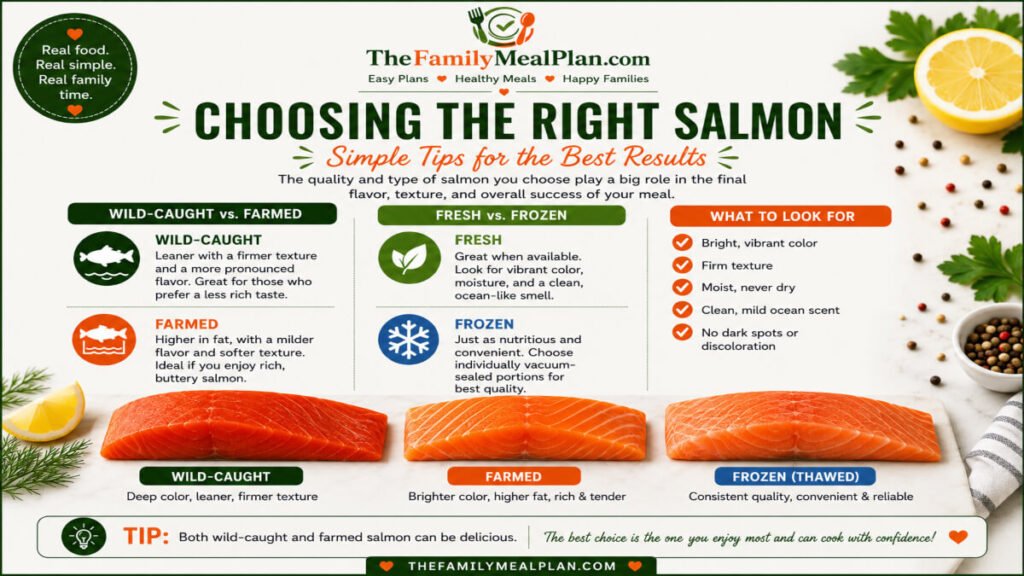
The type and quality of salmon you choose will influence not only the flavor of your dish, but also how forgiving the cooking process is. While technique plays a major role in the final result, starting with the right cut of fish makes everything easier.
Different varieties of salmon behave differently under heat.
Atlantic salmon, which is the most commonly available in grocery stores, has a higher fat content. This makes it more forgiving during cooking because the fat helps retain moisture even if the timing isn’t perfect. For this reason, it’s the best choice for beginners and for anyone looking for consistent results.
Sockeye salmon, on the other hand, is leaner and more firm. While it has a deeper, more pronounced flavor, it also cooks more quickly and can dry out faster if not monitored closely. Coho salmon sits somewhere in between, offering a balance of flavor and texture without being overly delicate.
Beyond the type of salmon, freshness and cut quality are just as important.
When selecting salmon, look for fillets that have a bright, vibrant color and a firm texture. The surface should appear moist but not slimy, and there should be no strong fishy odor. Thickness also matters—an evenly cut fillet will cook more consistently than one that tapers significantly from one end to the other.
Another important decision is whether to use skin-on or skinless salmon.
Skin-on fillets provide a natural barrier between the fish and the heat of the pan or baking sheet. This helps protect the flesh from direct heat exposure, reducing moisture loss and improving overall texture. The skin also makes handling the fish easier during cooking.
Skinless fillets can still be used successfully, but they require more attention to timing and temperature to prevent drying out.
In practical terms, if your goal is consistency and ease:
- Choose Atlantic salmon whenever possible
- Look for even thickness across the fillet
- Use skin-on cuts for better moisture retention
💡 The right cut of salmon doesn’t just improve flavor—it makes the entire cooking process more forgiving from start to finish.
Understanding which ingredients support the cooking process makes it much easier to get consistent, flavorful results. This quick visual guide highlights the essentials.
Core Ingredients for Baking Salmon
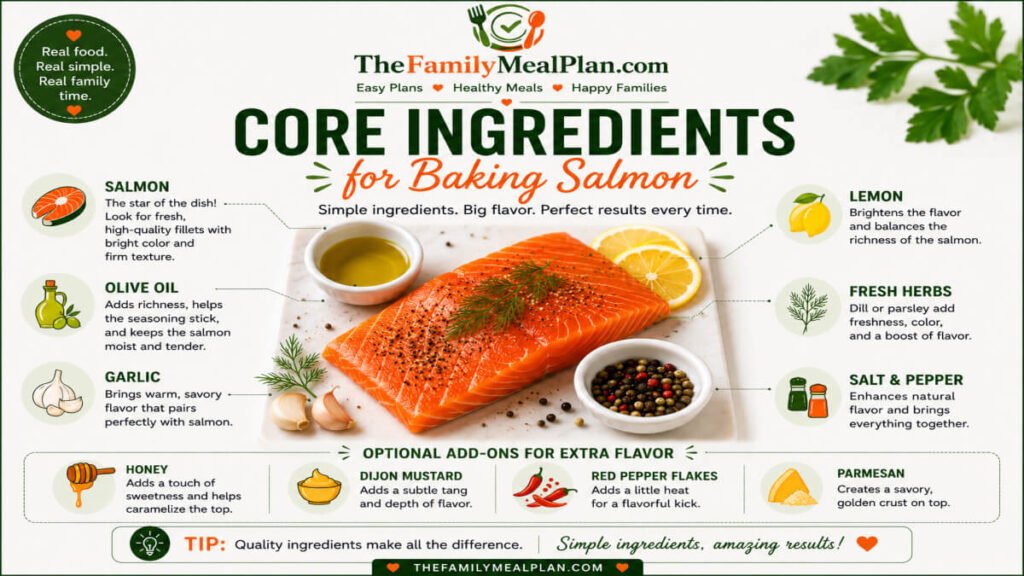
Salmon is naturally rich and flavorful, which means the goal here isn’t to build complexity—it’s to support the cooking process with a few well-chosen ingredients that enhance texture, balance, and overall results.
Because of that, seasoning should be used with intention. Rather than overpowering the fish, each ingredient should work to highlight its natural qualities while maintaining a clean, balanced flavor.
At its core, you only need a few basic ingredients to create a well-balanced dish.
A light coating of oil or butter helps conduct heat evenly across the surface of the fish while also contributing to moisture retention. Salt plays a critical role in bringing out the natural flavor of the salmon, while black pepper adds a subtle layer of warmth and depth.
From there, you can build additional flavor using simple, fresh ingredients that pair naturally with fish.
Garlic adds a savory base note, while lemon provides brightness that cuts through the richness of the salmon. Herbs like parsley or dill contribute freshness without overwhelming the dish, and spices like paprika can add mild complexity without dominating the flavor profile.
The key is restraint.
Using too many ingredients or overly strong seasonings can mask the natural qualities of the salmon, making it harder to recognize when the fish is cooked properly and reducing the overall balance of the dish.
A simple, effective ingredient structure looks like this:
- A fat component (olive oil or butter)
- A base seasoning (salt and pepper)
- One or two complementary flavor enhancers (lemon, garlic, herbs)
This approach keeps the focus on the salmon itself while still allowing you to adjust the flavor profile to match your preferences.
💡 Once you understand the core ingredients and structure behind a well-balanced salmon dish, it becomes much easier to adapt the method to different cooking styles and dietary preferences.
Vegan & Plant-Based Variations
This visual guide shows how the same flavor-building principles can be applied using flexible plant-based ingredients and simple substitutions.
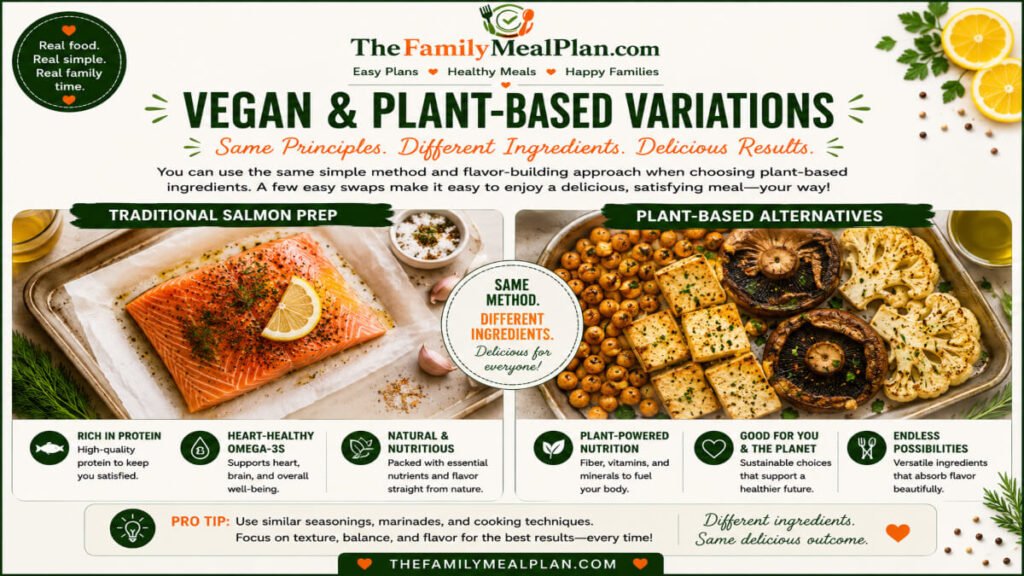
Many of the principles used to bake salmon perfectly can also be applied to plant-based ingredients, making this method more flexible than it might seem at first. While salmon has a naturally rich texture due to its fat content, you can still achieve satisfying, well-balanced results by choosing plant-based alternatives that respond well to controlled heat.
The goal isn’t to replicate salmon exactly—it’s to apply the same cooking logic to different ingredients. By focusing on texture, moisture retention, and balanced seasoning, you can create a plant-based version that still feels complete and satisfying as part of a meal.
For a fully plant-based approach, consider using ingredients that hold their structure during cooking and absorb flavor effectively.
Recommended Plant-Based Alternatives
- Firm or extra-firm tofu
Holds its shape well and absorbs marinades easily, making it one of the most reliable substitutes for structured, oven-baked dishes - Chickpeas or white beans
Provide a softer texture and work well when seasoned and roasted, especially for bowl-style meals or skillet variations - Portobello mushrooms
Offer a more substantial, meaty texture and can be roasted or baked using similar temperature guidelines - Cauliflower steaks
A versatile option that develops a tender interior with slight crisping on the edges when baked properly
Adjusting the Cooking Method
Because plant-based ingredients behave differently than fish, a few small adjustments help maintain the best results:
- Use slightly higher seasoning levels to build flavor depth
- Add a bit more oil to support moisture retention
- Monitor texture rather than internal temperature for doneness
- Expect shorter or longer cook times depending on density
Flavor Building Tips
The same ingredient structure used for salmon applies here:
- A fat component (olive oil or plant-based butter)
- A base seasoning (salt, pepper, garlic)
- Brightness (lemon juice or vinegar)
- Optional herbs for freshness
This keeps the dish balanced while allowing the main ingredient to remain the focus.
💡 Whether you’re preparing salmon or experimenting with plant-based alternatives, having the right equipment helps create more consistent and reliable results from start to finish.
Equipment You’ll Need
The equipment used to bake salmon is straightforward, but each item plays a specific role in ensuring the fish cooks evenly and releases cleanly after baking. While you don’t need a specialized setup, using the right tools helps eliminate small issues that can affect the final result.
At the center of your setup is a standard baking sheet. This provides a flat, stable surface that allows heat to circulate evenly around the salmon. Choosing a sheet with a light-colored finish can help prevent excessive browning on the bottom of the fish.
Lining the baking sheet is equally important.
Using parchment paper or foil creates a barrier between the salmon and the surface of the pan. This prevents sticking, reduces cleanup, and helps maintain the integrity of the fillet when it’s time to remove it from the oven. Parchment paper is generally preferred because it allows for better airflow and prevents the fish from steaming.
An instant-read thermometer is one of the most valuable tools you can use.
While visual cues are helpful, temperature provides certainty. Being able to quickly check the internal temperature of the salmon allows you to remove it from the oven at exactly the right moment, reducing the risk of overcooking.
A small brush can be useful for applying oil or melted butter evenly across the surface of the fish, ensuring consistent coverage without excess pooling.
Finally, a sharp knife helps with portioning and trimming if needed, allowing you to create evenly sized pieces that cook at the same rate.
In summary, your setup should include:
- A baking sheet for even cooking
- Parchment paper or foil for non-stick support
- An instant-read thermometer for accuracy
- A brush for even seasoning application
- A knife for portion control
These tools don’t add complexity—they remove uncertainty.
💡 Good equipment doesn’t make cooking harder—it makes the outcome more predictable.
Beginner vs Advanced Methods
Not every cook approaches salmon the same way, and that’s where having multiple methods can be useful. The key is choosing the approach that matches your comfort level and the result you’re aiming for.
For most home cooks, especially those prioritizing consistency and ease, a straightforward baking method is the best place to start.
The beginner method focuses on stability. By using a moderate oven temperature and simple seasoning, it creates a controlled environment where the margin for error is wider. This allows you to focus on learning doneness cues without the added pressure of managing multiple variables at once.
This method is ideal if your goal is to:
- Build confidence in cooking salmon
- Achieve consistent results without guesswork
- Prepare quick, reliable weeknight meals
Once you’re comfortable with that foundation, you can move into a slightly more advanced approach that adds texture and depth of flavor.
The advanced method introduces a higher initial temperature or a finishing step, such as a brief broil, to create a lightly crisp exterior while maintaining a moist interior. This method requires closer attention, as the window between perfectly cooked and overdone becomes narrower.
It’s best suited for situations where you want to elevate presentation or add a bit more complexity to the final dish.
Both methods rely on the same core principles—temperature control, timing, and doneness—but they apply them in slightly different ways depending on your goal.
💡 Now that your setup is complete and your method is clear, the final piece is understanding exactly how temperature and timing work together to produce perfect results.
Temperature & Timing
Temperature and timing are the two variables that ultimately determine whether your salmon turns out perfectly cooked or falls short of expectations. While seasoning and preparation play important roles, it’s the interaction between heat and time that defines the final texture of the fish.
One of the most common mistakes home cooks make is relying on a fixed cooking time without considering thickness. Salmon fillets vary significantly in size, and a difference of even half an inch can change the cooking time by several minutes. Because of this, time should always be treated as a guide rather than a rule.
Temperature, on the other hand, sets the pace of cooking.
A moderate oven temperature—around 375°F—creates a controlled environment where the salmon cooks evenly without rushing the process. This slower, steadier approach allows the proteins to set gradually, preserving moisture and reducing the risk of overcooking.
Higher temperatures, such as 400°F or 425°F, can be used to shorten cooking time, but they narrow the margin for error. At these temperatures, the outer layers of the fish cook more quickly, which can lead to a firmer texture if the salmon is left in the oven too long.
Understanding how these variables work together allows you to adjust your approach based on the situation. If you’re cooking quickly on a busy night, a slightly higher temperature may be appropriate. If consistency and moisture are your priority, a lower, more forgiving temperature is the better choice.
To provide a clear reference point, the following chart outlines approximate baking times based on thickness and temperature:
| Thickness | 375°F | 400°F | 425°F |
|---|---|---|---|
| 1 inch | 12–15 minutes | 10–12 minutes | 8–10 minutes |
| 1.5 inch | 15–18 minutes | 12–15 minutes | 10–12 minutes |
| 2 inch | 18–22 minutes | 15–18 minutes | 12–15 minutes |
These ranges account for natural variation in ovens and fish, but the most reliable guideline remains consistent:
- Plan for roughly 10 minutes of cooking time per inch of thickness
This rule provides a strong starting point, but it should always be paired with visual and temperature-based doneness checks to ensure accuracy.
💡 Time gives you direction—but temperature and observation give you control.
Knowing exactly when salmon is done is one of the most important steps in achieving tender, flaky results. This visual guide highlights the key signs to look for.
How to Know When Salmon is Done
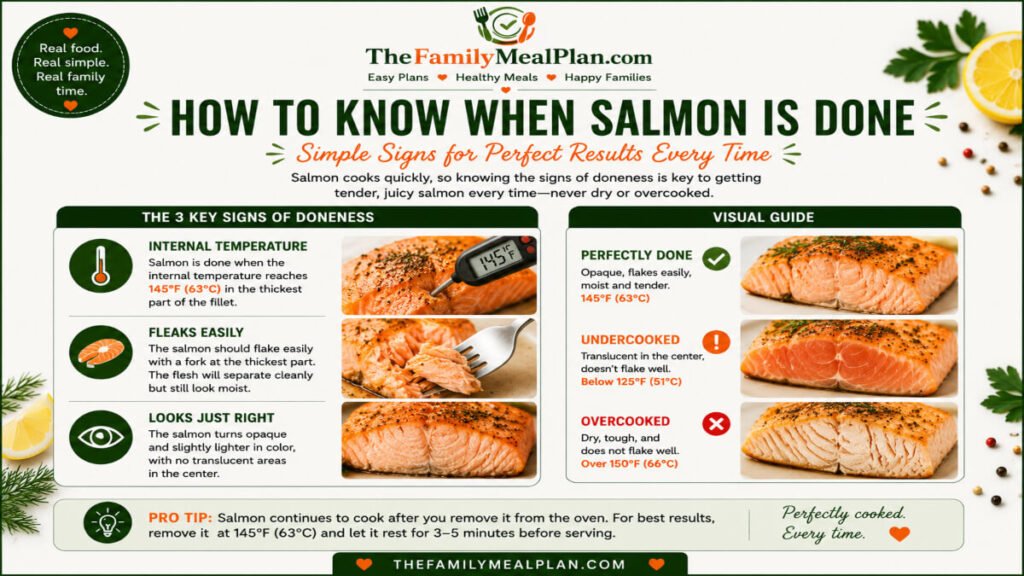
Recognizing when salmon is properly cooked is one of the most valuable skills you can develop, because it removes uncertainty from the entire process. Instead of relying solely on time, you begin to read the fish itself—using visual and physical cues to determine doneness with confidence.
One of the most reliable indicators is the way the salmon flakes.
As the fish cooks, the muscle fibers begin to separate. When you insert a fork into the thickest part of the fillet and gently twist, the layers should begin to separate easily. This flaking action indicates that the proteins have set, but the fish still retains moisture.
Texture also plays an important role.
Perfectly cooked salmon should feel tender and slightly firm, but not stiff. If it resists flaking or appears glossy and raw in the center, it needs more time. If it feels firm throughout and flakes aggressively, it may already be overcooked.
Temperature provides an additional layer of certainty.
An internal temperature between 125°F and 130°F produces a moist, buttery texture that many people consider ideal. At this stage, the salmon is fully cooked but still retains a slight translucency in the center. Cooking to 135°F–145°F results in a firmer, more traditional “fully done” texture.
It’s important to remember that salmon continues to cook after it’s removed from the oven. This carryover cooking means that pulling the fish slightly early will often result in a better final texture.
Visually, the center of the salmon should appear just slightly translucent—not raw, but not fully opaque either. The outer layers will be lighter in color and fully set, creating a contrast that indicates proper doneness.
💡 Perfect doneness isn’t about hitting a number—it’s about recognizing the moment when texture, temperature, and appearance all align.
This step-by-step visual guide walks through the entire process, making it easy to follow and repeat with consistent results every time.
How to Bake Salmon Perfectly: Step-by-Step
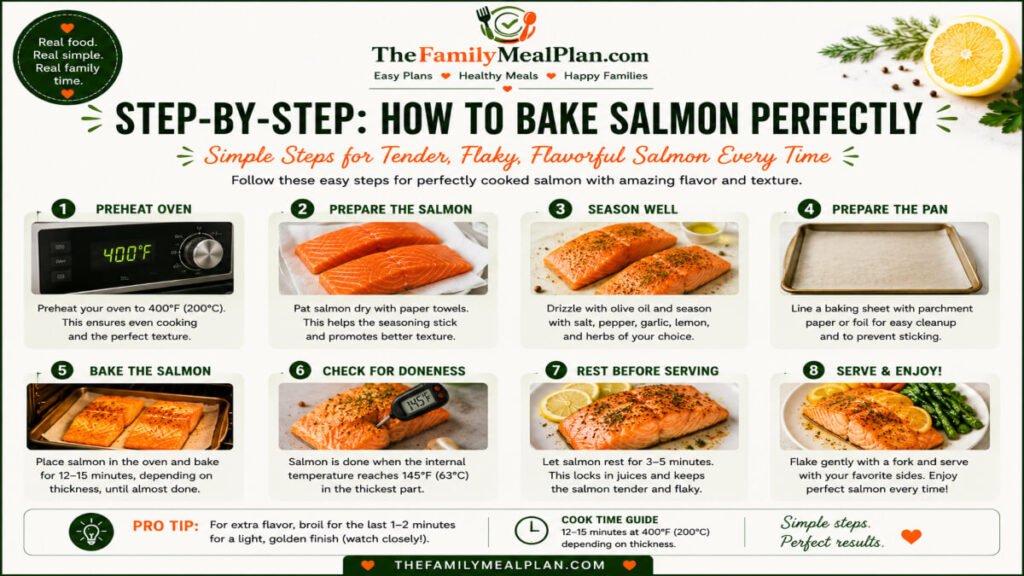
Executing the baking process correctly comes down to following a sequence of small, intentional steps. Each step builds on the previous one, creating a controlled environment that leads to consistent results.
Begin by preheating your oven to 375°F. Starting with a fully preheated oven ensures that the salmon begins cooking immediately and evenly. Placing fish into an oven that is still heating can lead to uneven texture and unpredictable timing.
Next, prepare the salmon.
Pat the fillets dry using paper towels. This step is often overlooked, but it plays a critical role in texture. Removing excess surface moisture allows the fish to bake rather than steam, which helps maintain a firmer, more desirable consistency.
Place the salmon on a lined baking sheet, skin-side down. The skin acts as a protective barrier, helping to regulate heat exposure and preserve moisture in the flesh.
Apply a light coating of oil or melted butter across the surface of the fish. This not only enhances flavor but also promotes even heat distribution during cooking. Season with salt, pepper, and any additional flavor elements such as garlic, lemon, or herbs.
Transfer the baking sheet to the center rack of the oven.
Positioning matters—placing the salmon too close to the top or bottom can result in uneven cooking. The center rack provides the most balanced heat exposure.
Allow the salmon to cook undisturbed, using your timing guidelines as a reference point. Avoid opening the oven repeatedly, as this causes temperature fluctuations that can affect consistency.
As the cooking time approaches its lower range, begin checking for doneness. Use the fork test or an instant-read thermometer to assess the internal temperature.
Once the salmon reaches the desired doneness, remove it from the oven and allow it to rest for two to three minutes. This short resting period allows the internal temperature to stabilize and moisture to redistribute throughout the fillet.
💡 Consistency isn’t created by one big step—it’s built through a series of small decisions executed correctly.
By this point, you’ve got a complete, reliable process for baking salmon. If you’re looking to make weeknight cooking even easier, this is where everything starts to come together.

Now that you’ve got the process down, let’s take a closer look at the most common mistakes—so you can avoid the small details that often lead to inconsistent results.
Common Mistakes
Mistakes in cooking salmon are rarely caused by lack of effort—they’re usually the result of small oversights that compound during the process. Understanding these common issues helps you avoid them before they affect your results.
Overcooking is by far the most frequent problem.
Because salmon continues to cook after it’s removed from the oven, leaving it in until it looks fully done often results in a dry texture. Removing the fish slightly early is one of the simplest ways to improve consistency.
Skipping the drying step is another common oversight.
When surface moisture is left on the fish, it interferes with the baking process by creating steam. This leads to a softer, less structured texture that can feel mushy rather than flaky.
Cooking salmon directly from the refrigerator can also create uneven results.
Cold fish placed into a hot oven cooks unevenly, with the outer layers heating more quickly than the center. Allowing the salmon to sit at room temperature for a short period before baking helps ensure more even cooking.
Finally, over-seasoning can mask the natural flavor of the fish.
Salmon has a distinct taste that benefits from subtle enhancement rather than heavy seasoning. Using too many ingredients can overwhelm the dish and make it harder to evaluate doneness based on flavor and texture.
💡 Most mistakes aren’t dramatic—they’re small details that quietly shift the outcome.
Pro Tips
Refining your approach to baked salmon doesn’t require major changes—just a few strategic adjustments that enhance consistency and elevate the final result.
Using parchment paper instead of foil improves airflow around the fish, preventing excess moisture from accumulating underneath. This helps maintain a cleaner texture and makes removal easier.
Adding lemon slices on top of the salmon during baking introduces gentle acidity that balances the richness of the fish without overpowering it. As the salmon cooks, the lemon releases moisture and aroma that subtly enhances flavor.
Keeping the salmon skin-side down throughout the cooking process provides a natural barrier that protects the flesh from direct heat. Even if you don’t plan to eat the skin, leaving it on during baking improves overall texture.
For those looking to add a slight variation in texture, finishing the salmon under the broiler for one to two minutes can create a lightly crisp surface while preserving a moist interior. This step should be used carefully, as the transition from perfectly cooked to overdone happens quickly under high heat.
💡 Small refinements don’t complicate the process—they sharpen the result.
This visual guide highlights a variety of side dishes that pair perfectly with baked salmon, making it easy to build a balanced and satisfying meal.
What to Serve with Baked Salmon
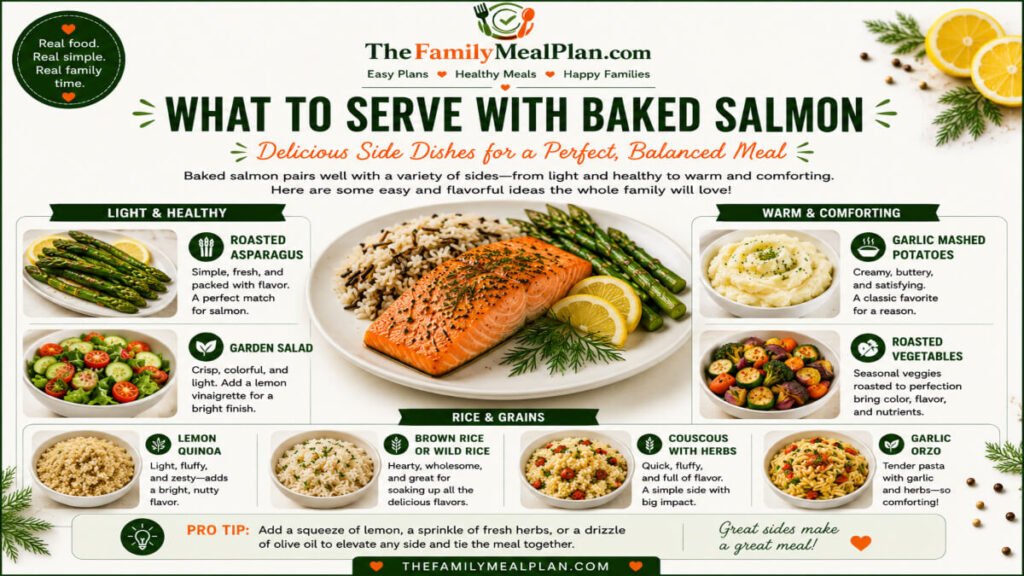
Once you’ve mastered baking salmon, the next step is building a complete meal around it. Salmon’s versatility makes it an ideal centerpiece for a wide range of side dishes, allowing you to adapt it to different preferences and dietary goals.
Because salmon is rich and flavorful, it pairs well with sides that provide contrast.
Lighter options such as fresh salads introduce brightness that complements the natural richness of the fish, making this an easy addition to your healthy recipes rotation.
The goal is not to create complexity, but to build a plate that feels complete without requiring additional effort.
A well-balanced salmon meal typically includes:
- A protein (the salmon itself)
- A vegetable component for texture and nutrition
- A grain or starch for balance and satiety
This structure allows you to mix and match components based on what you have available, making salmon an adaptable choice for both planned meals and last-minute dinners.
💡 When your main dish is reliable, the rest of the meal becomes easier to build.
Build the Meal Around This
Learning the technique is what gives you control—but applying it in a full recipe is what turns that skill into a repeatable dinner you can rely on.
This is where everything comes together.
Instead of thinking through each step individually, you can follow a complete, structured recipe that walks you through the entire process—from preparation to serving—with consistent, reliable results.
Ready to put this into practice? Try this:

This recipe takes everything you’ve just learned and simplifies it into a clear, repeatable process you can rely on any night of the week.
Instead of focusing on individual steps, you’re following a complete system—from preparation to plating—that ensures consistent, flavorful results every time.
💡 Technique builds confidence—but a complete recipe turns that confidence into a meal you can serve.
Frequently Asked Questions
When it comes to cooking salmon, most questions come down to one thing: confidence. Even after learning the basic method, it’s natural to wonder whether small adjustments—like temperature, covering the fish, or starting from frozen—will affect the outcome.
Understanding these details helps remove hesitation and reinforces consistency in your results.
This section is designed to remove that uncertainty. By answering the most common questions directly, you can approach the cooking process with clarity instead of hesitation, making each step more predictable and easier to execute.
What temperature should salmon be cooked to?
Cooking salmon to the right internal temperature is one of the most reliable ways to ensure consistent results, but it’s important to understand that “done” doesn’t always mean the same thing for everyone.
For a moist, tender texture, salmon is best removed from the oven when it reaches an internal temperature of around 125°F to 130°F. At this stage, the fish is fully cooked but still retains a slight translucency in the center, which contributes to its buttery consistency.
Cooking the salmon to higher temperatures, such as 135°F to 145°F, results in a firmer texture that some people prefer, but it also increases the likelihood of moisture loss. Because salmon continues to cook after it’s removed from the oven, pulling it slightly early helps preserve its ideal texture without risking undercooking.
Do I need to bring salmon to room temperature before baking?
Allowing salmon to sit at room temperature for a short period before baking can improve how evenly it cooks, but it’s not always required.
When cold salmon is placed directly into a hot oven, the outer layers begin cooking much faster than the center. This can lead to uneven texture, especially in thicker fillets. Letting the fish rest at room temperature for about 10 to 15 minutes before cooking helps reduce this temperature gap, allowing for more consistent results.
That said, if you’re short on time, you can still bake salmon straight from the refrigerator. The difference is subtle, but for best consistency—especially when learning the method—bringing it slightly closer to room temperature is a helpful step.
How do I keep salmon from drying out?
The most important factor in preventing dry salmon is controlling both temperature and timing. Cooking at a moderate oven temperature, such as 375°F, allows the fish to cook evenly without forcing moisture out too quickly. Just as important is removing the salmon slightly before it appears fully done, since it will continue to cook from residual heat after leaving the oven.
Moisture loss is often the result of staying in the oven too long—not using the wrong ingredients.
In practical terms, the goal is to stop cooking when the salmon is just set and still slightly tender in the center.
Is it better to bake salmon covered or uncovered?
For most situations, baking salmon uncovered produces the best results.
Covering the fish traps steam, which softens the outer layer and can lead to a slightly mushy texture. While this method can help retain moisture, it does so at the expense of structure and overall mouthfeel.
Baking uncovered allows the exterior to set properly while the interior remains moist, creating a better balance between texture and tenderness.
If additional moisture is needed, it’s more effective to use oil, butter, or lemon rather than covering the fish completely.
Should I bake salmon skin-side down?
Yes—baking salmon skin-side down is the preferred method.
The skin acts as a protective barrier between the fish and the hot surface of the baking sheet. This reduces direct heat exposure to the delicate flesh and helps preserve moisture during cooking.
Even if you don’t plan to eat the skin, leaving it on during baking improves the final texture and makes handling the fish easier.
Can I bake frozen salmon?
Yes, salmon can be baked directly from frozen, but the process requires slight adjustments.
Frozen salmon releases additional moisture as it cooks, which can affect both texture and seasoning. Because of this, cooking time will need to be extended, typically by 5 to 10 minutes depending on thickness.
For best results, begin baking the salmon as-is, then season it once the surface has thawed enough for the ingredients to adhere properly.
While fresh salmon provides more control and consistency, frozen salmon can still produce good results when handled correctly.
💡 The more clarity you have before cooking, the fewer decisions you have to make during it—and that’s what creates consistency.
How to Store & Reheat Salmon
Proper storage and reheating are often overlooked, but they play a critical role in maintaining the quality of your salmon after it’s been cooked. When handled correctly, leftover salmon can retain much of its original texture and flavor, making it a practical option for meal prep and next-day meals.
The key is managing moisture and heat carefully.
How to Store Cooked Salmon
After cooking, allow the salmon to cool slightly before storing it. Placing hot salmon directly into a sealed container can create condensation, which leads to excess moisture buildup and affects texture.
Once cooled, transfer the salmon to an airtight container and store it in the refrigerator. It will keep well for up to three days when stored properly.
If you plan to store multiple portions, consider separating them into individual containers. This makes reheating easier and prevents repeated exposure to air each time the container is opened.
Can You Freeze Cooked Salmon?
Cooked salmon can be frozen, but it’s important to understand how freezing affects texture.
While the flavor will remain intact, the structure of the fish may soften slightly after thawing due to moisture redistribution. This doesn’t make it unusable—it simply changes the ideal way to serve it.
If freezing, wrap the salmon tightly to minimize air exposure and store it for up to two months. Thaw overnight in the refrigerator before reheating.
Best Way to Reheat Salmon – Without Drying It Out
Reheating salmon successfully comes down to using gentle heat.
The oven is the best method for maintaining texture. Set it to around 300°F and allow the salmon to warm gradually. Covering it loosely can help retain moisture without creating excess steam.
Microwaving is faster, but requires caution. Use short intervals and add a small amount of moisture—such as a damp paper towel—to prevent the fish from drying out.
Avoid high heat during reheating, as it will continue to cook the salmon rather than simply warming it, leading to dryness.
How do I prevent salmon from smelling strong when reheating?
One common concern when reheating salmon is the stronger aroma that can develop, especially when using higher heat or enclosed spaces. While this is a natural result of reheating fish, there are a few simple ways to minimize it without compromising the quality of the meal.
The most effective approach is to use lower, gentler heat. Reheating salmon slowly in the oven at around 300°F reduces the intensity of the smell compared to high-heat methods like microwaving at full power. Keeping the temperature controlled prevents the oils in the fish from breaking down too quickly, which is what contributes to a stronger odor.
Ventilation also plays an important role. Allowing air to circulate—whether by using a loosely covered dish in the oven or ensuring proper airflow in the kitchen—helps disperse any lingering smell more quickly.
If reheating in the microwave, using short intervals and covering the salmon with a damp paper towel can help contain moisture and slightly reduce the intensity of the aroma.
While some level of scent is unavoidable when reheating fish, using a gentle, controlled approach makes it far less noticeable and helps maintain a more pleasant cooking environment.
Pro Tips for Best Results
To make the most of leftover salmon and maintain its quality, a few small adjustments can make a noticeable difference in both texture and flavor.
- Reheat only once to maintain quality
- Add a small amount of oil or butter before reheating if needed
- Use leftover salmon in salads, bowls, or wraps to offset texture changes
💡 Storing and reheating properly isn’t just about leftovers—it’s about extending the quality of the meal you already made.
Final Takeaway
Perfect baked salmon is not the result of complicated techniques or specialized ingredients—it’s the outcome of understanding a few key principles and applying them consistently.
When you control temperature, respect timing, and learn to recognize doneness, salmon becomes one of the most dependable meals you can make. It shifts from something that feels uncertain into something you can execute with confidence every time.
The fundamentals are simple:
- Use a moderate, controlled oven temperature
- Adjust cooking time based on thickness
- Remove the fish slightly early to account for carryover cooking
- Rely on visual and physical cues—not just time
Once these habits become part of your routine, cooking salmon stops being a challenge and becomes a reliable solution for quick, healthy, and satisfying meals.
💡 Consistency in cooking doesn’t come from complexity—it comes from understanding and repeating what works.
Make Dinner Easier Every Week
By now, you’ve seen how much easier cooking becomes when you have a clear method to follow. Something as simple as learning how to bake salmon properly can turn a once uncertain meal into something you can rely on any night of the week.
But the real difference happens when that same level of clarity extends beyond one recipe.
When you know what you’re cooking ahead of time—and how to cook it—you spend less time deciding, less time stressing, and more time actually enjoying the process. Meals come together faster, grocery shopping becomes simpler, and dinner starts to feel predictable in the best way possible.
That’s exactly what weekly meal planning is designed to do.
Instead of figuring things out day by day, you have a structured plan that brings everything together—balanced meals, simple ingredients, and proven cooking methods that work in real life.
When you combine guides like this with a consistent meal plan, cooking stops feeling like a daily challenge and starts becoming part of a system that supports your routine.
“The goal isn’t just to cook one great meal—it’s to make every meal easier to plan, prepare, and enjoy.”
If you’re ready to take that next step, you can get simple, family-friendly meal plans delivered straight to your inbox each week. These plans are built around the same approach you’ve seen here—practical, reliable, and designed for busy schedules.
They help you:
- Eliminate last-minute dinner decisions
- Keep meals balanced without overthinking
- Make better use of the ingredients you already have
- Stay consistent with healthy, home-cooked meals
It’s a small shift that makes a big difference over time.
👉 Get your free weekly meal plan and start simplifying dinner today.