

Simple, Healthy Meals Your Family Will Actually Love—With a Done-for-You Plan
If you’ve ever found yourself standing in the kitchen at the end of a long day, staring into the fridge and wondering what to make for dinner, you’re not alone. For many families, dinner isn’t just about cooking—it’s about managing time, energy, budget, and expectations all at once. And when there’s no clear plan in place, even the simplest meal can start to feel overwhelming.
This is where most people get stuck.
It’s not that there aren’t enough recipes available. In fact, the problem is often the opposite—too many options, not enough structure. When every night requires a new decision, dinner becomes a daily problem to solve instead of a routine you can rely on.
That’s exactly what this 6 easy family dinner meal plan is designed to change.
Instead of approaching dinner one day at a time, this plan gives you a structured, repeatable system built around meals that are simple, practical, and designed to work together across the week. Each recipe is chosen not just for flavor, but for how it fits into your schedule, how it uses ingredients efficiently, and how it helps reduce the overall effort required to cook at home consistently.
At the center of this approach is what we call the Family Dinner System—a simple framework that focuses on consistency, flexibility, and real-life practicality. It’s not about cooking perfectly or following strict rules. It’s about building a routine that makes dinner easier to manage week after week.
When you have a system in place, everything changes. You spend less time deciding, less time prepping, and less time stressing about what’s next.
With this meal plan, you’ll start to:
- Eliminate last-minute dinner decisions
- Reduce grocery waste and unnecessary spending
- Build a predictable, manageable weekly routine
- Feel more confident in your ability to cook consistently
Over time, these small improvements create a noticeable shift—not just in how you cook, but in how your entire evening feels.
💡A simple plan only works when it fits into your everyday routine—not just one night at a time.
Explore More Easy Recipes
Before we break down this specific meal plan, it’s important to understand how it fits into a bigger picture. This plan isn’t meant to exist on its own—it’s part of a broader approach to cooking that becomes more effective the more you use it.
If you’re building a collection of meals you can rely on, this plan works alongside your go-to 30-minute meals, healthy recipes, budget meals, and family dinners. These categories aren’t just helpful for organizing recipes—they represent a framework for how you approach cooking throughout the week.
Most people treat each dinner as an isolated decision. They search for something new, shop for it, cook it, and repeat the process the next day. Over time, this becomes exhausting because there’s no connection between meals.
But when you start thinking in terms of systems instead of individual recipes, you begin to see how everything can work together.
You start to build a rotation:
- A few quick meals you can rely on when time is tight
- A few comfort meals that feel satisfying and familiar
- A few lighter meals that help balance things out
These meals begin to overlap in ingredients, preparation, and timing. You become faster in the kitchen because you’re repeating similar techniques. Grocery shopping becomes easier because you’re buying with intention instead of guessing.
This is how the Family Dinner System works in practice.
It doesn’t require complicated planning or strict rules. Instead, it creates a flexible structure where meals support each other, and your week starts to feel more organized without extra effort.
Over time, this approach helps you:
- Reduce the number of decisions you make each day
- Build confidence through repetition
- Spend less time searching for ideas
- Create a routine that actually fits your life
The result isn’t just better meals—it’s a better experience around dinner as a whole.
💡Once you start building meals this way, the next step is making sure you always have a plan ready when you need it
Save This Meal Plan for Later
Don’t lose this meal plan—save it now so it’s easy to come back to when you need it most.
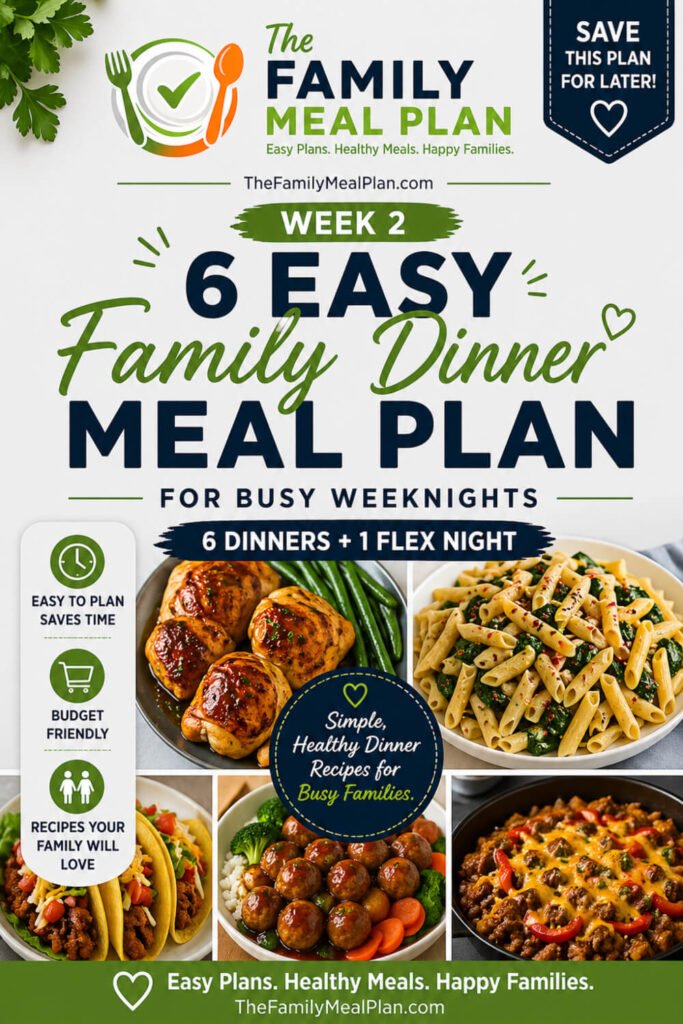
💡Having a plan ready when you need it makes all the difference—especially on busy weeknights.
Saving this meal plan now makes it easy to come back to whenever you need a simple, reliable dinner plan for your week.
Once you’ve saved this plan, you’ve already taken an important step. You’ve given yourself a resource you can return to instead of starting from scratch the next time dinner feels uncertain.
That’s one of the biggest advantages of building a system—you don’t have to rely on memory or motivation. The plan is already there when you need it.
💡Now that you’ve saved this plan, let’s break down exactly how it works and why it makes your week easier.
Understanding How This Plan Works
Now that you’ve saved this meal plan, let’s take a closer look at how it actually works and why it’s designed the way it is.
At a glance, this might look like a simple collection of recipes—but what makes it effective is the structure behind it. Each meal has a role to play, and each day builds on the previous one in a way that reduces effort over time.
This is where the shift happens—from simply following recipes to understanding a system.
When meals are planned with intention, something important changes. Cooking becomes less about reacting to the moment and more about following a clear, manageable path. Instead of asking “what should I make tonight?” you already know the answer—and more importantly, you’re prepared for it.
This structure doesn’t just make cooking easier—it changes how your entire week feels. You spend less time worrying about dinner and more time focusing on everything else that matters.
💡This isn’t just a list of meals—it’s a system designed to simplify your week from start to finish.
What This Weekly Meal Plan Includes
At first glance, this meal plan may appear to be a straightforward list of dinners—but the real value comes from how it’s structured. Every part of this plan is designed to work together, creating a system that reduces effort and increases consistency across your entire week.
This plan includes six complete dinners, each selected for its ability to be both practical and satisfying. These meals are balanced in a way that prevents the week from feeling repetitive while still maintaining simplicity. Alongside these six meals is a built-in flex night, which plays a critical role in making the plan sustainable.
The structure of this plan can be understood in three layers: what’s included, how it functions, and what it ultimately improves.
What’s Included
At the most basic level, this plan provides:
- Six fully planned dinner meals
- One flexible night for adjustments or leftovers
- A shared ingredient base across multiple meals
- A mix of cooking methods that repeat throughout the week
This gives you a clear roadmap for dinner without requiring additional planning.
How It Works
What makes this plan effective is how the meals connect to each other.
Ingredients are reused in a way that reduces waste and simplifies shopping. Preparation becomes easier as the week progresses because you’re already working with familiar components. Cooking methods repeat, allowing you to build speed and confidence without needing to learn something new each night.
Instead of treating each meal as a separate task, this plan creates a flow where each day supports the next.
What It Improves
Over time, this structure leads to meaningful improvements in your routine.
You begin to notice:
- Less stress around dinner decisions
- Faster preparation and cooking times
- More efficient grocery shopping
- A greater sense of control over your week
These changes may seem small at first, but they add up quickly. Dinner becomes less of a daily challenge and more of a predictable, manageable part of your routine.
Why This Matters
The difference between a simple meal plan and a structured system is consistency.
Anyone can follow a plan for a few days. But a plan that is designed to adapt, simplify, and support your routine is something you can continue using long-term.
💡When a plan is structured this way, the benefits show up quickly in your daily routine.
Why You’ll Love This Meal Plan
One of the biggest challenges families face when it comes to dinner isn’t cooking—it’s everything that happens before cooking even begins. The mental effort of deciding what to make, checking what’s in the fridge, figuring out what’s missing, and trying to balance time, cost, and nutrition all adds up quickly. By the time you actually start cooking, you’re already mentally exhausted.
That’s where a structured meal plan like this creates an immediate difference.
Instead of approaching dinner as a new problem every day, you’re following a plan that has already accounted for your time, your budget, and your energy. That shift alone removes a significant amount of stress from your week. You’re no longer reacting—you’re executing.
Another major benefit is efficiency. When meals are connected through shared ingredients and similar cooking methods, everything becomes easier. Grocery shopping becomes more focused because you’re buying with intention. Preparation becomes faster because you’re working with ingredients you’ve already handled earlier in the week. Even cleanup tends to improve because you’re repeating familiar processes instead of starting from scratch.
There’s also a level of consistency that develops naturally. When meals are simple and repeatable, you’re far more likely to stick with home cooking. Instead of relying on takeout during busy nights, you already have a plan in place that feels manageable. That consistency is what ultimately leads to better habits and better outcomes over time.
Just as important, this plan creates balance without requiring constant attention. You don’t have to track anything or overthink your meals. The structure itself ensures that your week includes a mix of satisfying comfort meals, lighter options, and quick dinners that fit your schedule.
With this plan, you’ll notice:
- Less time spent deciding what to cook
- Faster preparation during the week
- More efficient grocery shopping
- A more predictable and manageable evening routine
Over time, these benefits build on each other. Cooking becomes less stressful, more consistent, and far easier to maintain.
💡The real difference comes from how your week is structured—not just what you cook.
Week Structure Logic
At first glance, the order of meals in a weekly plan might seem random—but in a well-structured system, there’s a clear logic behind how the week is organized.
This meal plan is intentionally designed to match how energy, time, and motivation naturally fluctuate throughout the week.
At the beginning of the week, you typically have more energy and a greater willingness to cook. That’s why the plan starts with meals that are slightly more involved or more satisfying, such as creamy or protein-rich dishes. These meals set the tone for the week and help you start strong without feeling overwhelmed.
As the week progresses, schedules tend to get busier and energy levels begin to drop. Midweek meals are designed to be lighter, faster, and more efficient. These are the meals that rely on simpler cooking methods and take advantage of any preparation you’ve already done earlier in the week.
Toward the end of the week, flexibility becomes more important. This is where meals become more relaxed—comforting, quick, and adaptable. By this point, the goal is to maintain consistency without adding pressure.
The flex night at the end of the week is what ties everything together. It allows you to adjust based on how your week actually unfolded, rather than forcing you to follow a rigid plan.
This structure works because it aligns with real life:
- Early week = more energy, slightly more effort
- Midweek = efficiency and balance
- Late week = flexibility and simplicity
When your meal plan follows this natural rhythm, it becomes easier to stick with. You’re no longer fighting against your schedule—you’re working with it.
💡A well-structured week doesn’t just organize your meals—it matches the way your life actually works.
The 6-Day Dinner Plan
Each meal is designed to be simple, repeatable, and built around ingredients that work across your entire week.
This plan is designed to give you structure without feeling rigid. Each day builds on simple ingredients and repeatable techniques so you can move through the week with less effort and more confidence. Now that you understand how the structure works, let’s walk through each day of the plan and how it contributes to your week as a whole.

💡A simple plan works best when each meal builds naturally into your week.
Day 1 – Creamy Tuscan Chicken
The week starts with a rich and satisfying meal that feels comforting without being overly complicated. This dish sets the tone for the week, giving you a strong start while still being manageable in terms of preparation.
Because this meal uses ingredients like garlic, cream, and spinach, it also helps establish components that will carry into later meals, making future cooking steps easier.
Day 2 – Garlic Butter Steak Bites with Potatoes
On the second day, the focus shifts to a high-protein, one-pan style meal that delivers strong flavor with minimal complexity. Steak bites cook quickly, and pairing them with potatoes keeps the meal filling and balanced.
This meal also reinforces efficient cooking techniques, helping you build confidence and speed early in the week.
Day 3 – Healthy Chicken Vegetable Stir Fry
Midweek is where efficiency becomes critical. This stir fry introduces a lighter meal that comes together quickly while still delivering a balanced combination of protein and vegetables.
Because many of the vegetables are already prepped or reused from earlier in the week, this meal requires less effort than it might otherwise.
Day 4 – Lemon Herb Salmon with Vegetables
This meal brings in a fresh, clean option that helps balance out the heavier dishes from earlier in the week. Salmon cooks quickly and pairs easily with simple vegetables, making it an ideal midweek meal when time and energy are limited.
It also introduces variety, which helps prevent the week from feeling repetitive.
Day 5 – Creamy Garlic Chicken Pasta
As the week moves toward the end, this meal provides a familiar, comforting option that is easy to prepare and widely enjoyed. Pasta dishes tend to be quick and forgiving, making them perfect for nights when you want something reliable without too much effort.
Day 6 – Breakfast-for-Dinner Skillet
The final planned meal of the week is designed to be flexible and relaxed. Breakfast-for-dinner options are quick, adaptable, and easy to customize based on what you have available.
This helps reduce pressure while still maintaining consistency.
💡Even the best plan needs flexibility built in—and that’s where the flex night comes in.
Day 7 – Flex Night
This is where the plan adapts to your real life. Whether you use leftovers, cook something simple, or take a break from cooking altogether, this night gives you the flexibility you need to stay consistent without feeling restricted.
💡Each meal has a purpose—and together, they create a week that feels manageable from start to finish.
Flex Night
Flex nights are one of the most important—and most overlooked—parts of a successful meal plan.
Without flexibility, even the best plan can fall apart. Life is unpredictable. Schedules change, energy levels fluctuate, and unexpected events happen. When a plan doesn’t account for that, it becomes difficult to maintain. Flex nights are one of the most important parts of a sustainable meal plan because they allow real life to fit into your system without breaking it.
A flex night solves that problem by giving you built-in adaptability.
Instead of feeling like you’ve “failed” if you miss a meal, you simply shift things around. Maybe a dinner gets moved to the next day. Maybe leftovers are used instead of cooking something new. Maybe you take a night off entirely.
This flexibility reduces pressure and makes it much easier to stick with the plan over time.
Flex nights also play a practical role in reducing waste. Instead of letting extra food go unused, you have a designated opportunity to turn leftovers into something new or simply use what’s already available.
Common ways to use a flex night include:
- Combining leftovers into a new meal
- Making something quick and simple
- Skipping cooking and resting
Over time, this built-in flexibility becomes one of the key reasons the system works.
💡This small adjustment is what turns a meal plan into something you can actually stick with.
Why Flex Nights Make Meal Planning Work
To fully understand why this system is effective, it’s important to look at how flexibility impacts long-term consistency.
Most meal plans fail because they’re too rigid. They assume that every day will go exactly as planned, which rarely happens in real life. When something disrupts that plan, it becomes difficult to recover, and the entire structure can fall apart.
Flex nights act as a built-in recovery point.
They allow you to adjust without losing momentum. Instead of abandoning the plan, you simply adapt it. That small shift makes a significant difference in how sustainable the system feels over time.
There’s also a psychological benefit. When you know that your plan includes flexibility, it removes the pressure to get everything exactly right. That makes it easier to start and easier to continue.
From a practical standpoint, flex nights improve efficiency as well. They help you use ingredients more effectively, reduce food waste, and minimize unnecessary cooking.
This is why flex nights are essential:
- They make the plan adaptable
- They reduce pressure and stress
- They improve consistency over time
- They help you use what you already have
Without flexibility, most meal plans become temporary. With flexibility, they become sustainable.
💡With your weekly structure in place, the next step is making sure your kitchen is set up to support it.
Grocery Strategy – Designed for Efficiency, Not Just Convenience
A grocery list is one of the most overlooked parts of meal planning, yet it has one of the biggest impacts on how your week actually plays out. Most people approach grocery shopping as a reaction—they decide what meals they want, write down ingredients, and head to the store. The result is often a cart filled with disconnected items that don’t work together, leading to wasted food, extra spending, and more effort during the week.
This meal plan takes a different approach.
Instead of building a list around individual meals, it builds a list around a system. Ingredients are selected not only for what they contribute to a single recipe, but for how they can be used across multiple meals. This creates a level of efficiency that carries through your entire week—from shopping to prep to cooking.
When you shop this way, you begin to notice a shift. You’re no longer guessing or overbuying. You’re selecting ingredients with purpose, knowing exactly how they’ll be used and when.
How This Grocery Strategy Works
The key is intentional overlap.
Rather than introducing completely new ingredients for every meal, this plan reuses core items in a way that feels natural and efficient. Proteins, vegetables, and pantry staples are chosen to support multiple recipes, which reduces waste and simplifies preparation later in the week.
For example:
- Chicken is used in more than one meal, reducing the need for multiple protein purchases
- Vegetables like peppers and broccoli appear across different dishes
- Pantry staples provide a consistent base for several meals
This allows you to do more with fewer ingredients while maintaining variety.
Why This Approach Matters
When your grocery list is structured this way, everything becomes more manageable.
- You spend less time figuring out what to buy
- You avoid over-purchasing ingredients you won’t use
- You reduce preparation time during the week
- You create a smoother, more predictable cooking routine
Over time, this approach removes friction from your entire process.
💡A well-planned grocery strategy doesn’t just support your meals—it simplifies how your entire week comes together.
Budget + Cost Strategy: Feeding a Family Without Overspending
One of the biggest advantages of a structured meal plan is how naturally it supports your budget. When meals are planned in advance, spending becomes intentional instead of reactive, which is where most unnecessary costs tend to come from.
Without a plan, it’s easy to pick up extra items, forget what you already have, or buy ingredients that only get used once. Over time, that adds up—not just financially, but in wasted food and effort.
This meal plan avoids that by aligning your grocery list with your weekly structure before you ever step into the store.
When everything is planned ahead, you’re not guessing—you’re executing.

💡The way you shop shapes how your entire week flows.
This grocery list is designed to keep things simple, efficient, and easy to manage from the moment you step into the store.
Estimated Weekly Cost Breakdown
Proteins
| Ingredient | Amount | Estimated Cost |
|---|---|---|
| Boneless skinless chicken breast | 2 lbs | $8.00 |
| Sirloin steak (or similar cut) | 1 lb | $10.00 |
| Salmon fillets | 4 (5–6 oz each) | $12.00 |
| Eggs | 6 large | $3.00 |
Produce
| Ingredient | Amount | Estimated Cost |
|---|---|---|
| Broccoli florets | 2 cups | $2.50 |
| Bell peppers (mixed colors) | 3 medium | $3.00 |
| Zucchini | 2 medium | $2.00 |
| Potatoes (Yukon gold or red) | 2 lbs | $3.00 |
| Fresh spinach | 2 cups | $2.00 |
| Garlic | 1 bulb | $0.75 |
| Yellow onion | 1 large | $1.00 |
| Lemon | 1 whole | $0.75 |
Pantry Staples
| Ingredient | Amount | Estimated Cost |
|---|---|---|
| Dry pasta (penne or similar) | 1 lb | $2.00 |
| White or brown rice | 2 cups (dry) | $1.50 |
| Chicken broth | 2 cups | $2.00 |
| Soy sauce | 2–3 tbsp | $1.50 |
| Olive oil | 3–4 tbsp | $2.00 |
| Butter | 3 tbsp | $2.00 |
Dairy
| Ingredient | Amount | Estimated Cost |
|---|---|---|
| Heavy cream | 1 cup | $3.00 |
| Parmesan cheese (grated) | 1/2 cup | $3.00 |
| Shredded cheese (cheddar or blend) | 1 cup | $2.50 |
Optional Flavor Boosters
| Ingredient | Amount | Estimated Cost |
|---|---|---|
| Italian seasoning | 1–2 tsp | $1.00 |
| Red pepper flakes | 1/2 tsp | $0.50 |
| Fresh herbs (parsley or basil) | Small bunch | $2.00 |
Estimated Total Cost & Budget Strategy
Now that you’ve seen the full grocery list broken down by category, it’s helpful to step back and look at the overall cost of the week—and how this plan keeps your spending efficient without sacrificing quality.
Based on average U.S. grocery store pricing and the ingredient quantities listed above, this entire weekly meal plan comes in at approximately:
Estimated Total Cost: $60–$65 for the Week
Average Cost Per Serving: ~$2–$3
Why This Meal Plan Stays Budget-Friendly
The cost savings in this plan come from structure—not restriction.
Instead of cutting ingredients or reducing portions, this plan focuses on using ingredients more effectively across multiple meals. Many of the items you purchase are used more than once, which helps reduce waste and stretch your grocery budget further.
You’re also relying on a balanced mix of proteins, pantry staples, and produce, which keeps meals satisfying while avoiding unnecessary expense.
Simple Ways to Stretch Your Budget Even Further
If you want to adjust based on your household or current grocery prices, small changes can make a noticeable difference:
- Swap steak for chicken thighs or ground meat
- Use frozen vegetables when fresh prices are high
- Choose store-brand pantry staples
- Double lower-cost meals for additional servings
- Shop seasonal produce when available
These adjustments allow you to maintain the structure of the plan while tailoring it to your budget.
💡When your meals are planned with intention, your grocery budget becomes easier to control—and far more predictable.
With your grocery list and total cost mapped out, the next step is making sure your week runs smoothly once you’re in the kitchen.
Let’s walk through how a simple prep system can make cooking faster and more manageable during busy weeknights.
💡A well-structured plan doesn’t just save money—it helps everything run more smoothly throughout the week.
Meal Prep System – Making Weeknights Faster and Easier
Meal prep is often misunderstood as something that requires hours of work in advance, but in reality, even a small amount of preparation can significantly improve how your week feels.
The goal isn’t to cook everything ahead of time—it’s to remove the steps that slow you down later.
When ingredients are already washed, chopped, or portioned, cooking becomes much more straightforward. Instead of starting from scratch every night, you’re stepping into a process that’s already partially completed.
That shift makes a noticeable difference in both time and effort.
The Core Idea Behind Meal Prep
Think of meal prep as setting up your future self for success.
You’re not trying to finish meals in advance—you’re creating a smoother path so each dinner requires less effort than it otherwise would.
This approach keeps meals fresh while making them easier to execute.

💡A little preparation upfront can completely change how your week feels.
Start-of-Week Prep – 30–45 Minutes
At the beginning of the week, focus on a few key tasks that will have the biggest impact:
- Chop vegetables that will be used across multiple meals
- Portion and season proteins
- Prepare a base like rice or grains
This small upfront investment pays off throughout the week.
Midweek Reset – Optional but Helpful
As the week progresses, a quick reset can help maintain your rhythm:
- Replenish prepped ingredients
- Prepare additional items if needed
- Adjust based on how your week is going
This keeps everything running smoothly without requiring a full prep session.
Daily Cooking – Simplified Execution
With preparation already in place, daily cooking becomes more focused and efficient:
- You spend less time prepping
- You rely on familiar steps
- You move through meals more confidently
What You’ll Notice Over Time
As you follow this system, cooking begins to feel more manageable and less rushed. Instead of starting from zero each night, you’re building on what you’ve already prepared.
💡A small amount of preparation creates a smoother, more consistent cooking experience throughout the week.
How to Use This Meal Plan Successfully
Even the best meal plan only works if it fits into your real life. The goal isn’t to follow the plan perfectly—it’s to use it in a way that supports your schedule, your preferences, and your household.
One of the biggest mistakes people make is treating a meal plan as something rigid. When life doesn’t go exactly as planned, they feel like they’ve failed and abandon the plan altogether.
This approach is different.
This plan is designed to be flexible and adaptable. It gives you structure, but it also allows you to adjust as needed without losing momentum.
How to Make This Plan Work for You
Start by viewing the plan as a guide, not a rulebook. If a day doesn’t work, move meals around. If you don’t feel like cooking one night, use your flex day earlier.
Practical Ways to Adapt the Plan
- Swap proteins based on preference or availability
- Repeat meals your family enjoys most
- Adjust portion sizes for leftovers
- Shift meals based on your weekly schedule
Best Practices for Consistency
- Review the plan at the start of the week
- Prep ingredients ahead of time
- Keep meals simple when needed
- Focus on progress, not perfection
The more you adapt the plan to your life, the more effective it becomes.
💡A meal plan only works when it works for you—not the other way around.
How to Build Your Own Weekly Meal Plan
Once you’ve used a structured plan like this, the next step is learning how to create your own. This is where meal planning becomes truly sustainable—when you can apply the same system to different meals and different weeks without starting from scratch.
The key is to keep the process simple.
Start with a Basic Formula
Every meal should include:
- A protein
- A vegetable
- A base (rice, pasta, potatoes, etc.)
This creates balance without requiring complicated planning.
Build Your Weekly Structure
A simple rotation might look like:
- 2 chicken meals
- 1 beef meal
- 1 seafood meal
- 1 comfort meal
- 1 flexible or quick meal
This keeps your week varied while still being predictable.
Focus on Overlap and Efficiency
When building your plan:
- Choose ingredients that can be used multiple times
- Repeat cooking methods when possible
- Keep preparation manageable
Why This Matters
When you can build your own meal plan, you’re no longer dependent on finding new recipes or following someone else’s structure. You have a system that works regardless of what meals you choose.
Over time, this creates confidence and consistency in your cooking routine.
💡The goal isn’t to follow a plan forever—it’s to learn a system you can use anytime.
Common Meal Planning Mistakes (And How to Fix Them for Good)
Meal planning sounds simple in theory, but many people struggle to make it work consistently in real life. The issue usually isn’t effort—it’s approach. When the structure isn’t designed for how people actually live, even a well-intentioned plan can become difficult to maintain.
Understanding where things go wrong is one of the most effective ways to improve your results. When you recognize these common mistakes, you can adjust your approach and build a system that works long-term instead of something that only lasts for a few days.
Overcomplicating Meals
One of the most common mistakes is assuming that better meals require more complexity. People often try to cook elaborate recipes with long ingredient lists and multiple steps, especially at the start of the week. While this can feel productive at first, it quickly becomes overwhelming.
The reality is that consistency comes from simplicity. Meals that are easy to prepare and repeat are far more sustainable than ones that require significant time and attention.
How to fix it:
- Focus on simple, repeatable meals
- Use familiar cooking methods
- Limit the number of ingredients per recipe
Buying Too Many Unique Ingredients
Another issue is treating each meal as completely separate. This leads to grocery lists filled with one-time-use ingredients that don’t carry over into other meals. Not only does this increase your grocery bill, but it also creates unnecessary work during the week.
A more effective approach is to build meals around shared ingredients that can be used multiple times.
How to fix it:
- Choose recipes with overlapping ingredients
- Reuse vegetables, proteins, and pantry staples
- Build your list with efficiency in mind
Skipping Flexibility
Many meal plans fail because they don’t account for real-life changes. When every meal is locked into a specific day, even a small disruption can throw off the entire plan.
Flexibility is what allows a system to work consistently over time. Without it, plans become rigid and difficult to follow.
How to fix it:
- Always include a flex night
- Allow meals to shift between days
- Focus on progress, not perfection
Trying to Cook Everything Fresh Every Day
While cooking fresh meals every night sounds ideal, it’s rarely practical. Without any preparation, each dinner requires the same level of effort, which can quickly lead to burnout.
Meal prep doesn’t need to be extensive to be effective. Even small steps can make a big difference.
How to fix it:
- Prep ingredients ahead of time
- Cook components in advance
- Turn cooking into assembly when possible
Why Fixing These Matters
When you eliminate these mistakes, meal planning becomes far more manageable. Instead of feeling like a task you have to keep up with, it becomes a system that supports your routine.
💡Most meal planning struggles don’t come from lack of effort—they come from unnecessary complexity and lack of structure.
How to Store & Reheat – Keep Meals Fresh All Week
Cooking meals is only part of the process—how you store and reheat them has a direct impact on quality, taste, and how enjoyable those meals are later in the week.
When done correctly, leftovers can feel just as satisfying as freshly cooked meals. When done poorly, they can become dry, bland, or unappealing, which often leads to wasted food.
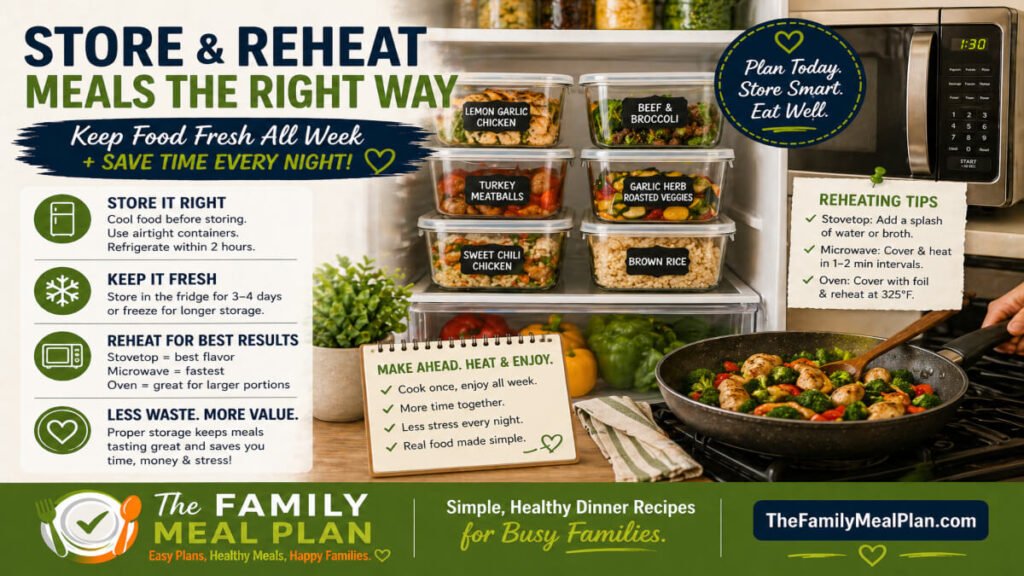
💡How you store and reheat your meals is just as important as how you cook them.
These simple strategies help keep your meals fresh, flavorful, and ready whenever you need them.
Proper Storage for Freshness and Safety
After cooking, allow meals to cool slightly before storing them. Placing hot food directly into containers can trap moisture and affect texture.
Use airtight containers to maintain freshness and prevent odors from spreading in the refrigerator. Glass containers are especially useful because they help retain quality and make reheating easier.
General storage guidelines:
- Refrigerate meals within 2 hours of cooking
- Store in airtight containers
- Use within 3–4 days for best quality
Freezing for Longer-Term Flexibility
Freezing can extend the life of many meals and provide additional flexibility in your schedule. This is especially helpful for dishes like pasta, cooked proteins, and rice-based meals.
When freezing:
- Portion meals into individual servings
- Use freezer-safe containers or bags
- Label with date and contents
Reheating Methods – Best Practices
The way you reheat your food can make a significant difference in how it tastes.
Stovetop (Best Quality)
- Ideal for most meals
- Allows control over heat and moisture
- Add a small amount of liquid if needed
Microwave (Fastest Option)
- Use short intervals
- Stir between heating
- Cover to retain moisture
Oven (Best for Larger Portions)
- Reheat at low temperature
- Cover to prevent drying out
Why This Matters
Proper storage and reheating turn leftovers into an advantage rather than an afterthought. They allow you to extend meals, save time, and maintain quality throughout the week.
What to Serve with These Meals – Building Balanced Plates
While each meal in this plan is designed to stand on its own, the right side dishes can elevate your dinner and help create a more balanced plate.
Instead of thinking of sides as an afterthought, it’s helpful to see them as a way to complement your main dish—adding texture, freshness, and variety without significantly increasing your workload.
How to Think About Pairings
A well-balanced meal typically includes:
- A protein (main dish)
- A vegetable or fresh component
- A starch or base
This combination helps create meals that are satisfying and complete.

💡The right sides turn a simple dinner into a complete, satisfying meal.
Simple Side Options That Work Across Multiple Meals
To keep things efficient, focus on sides that can be reused or prepared in advance:
- Roasted vegetables (broccoli, carrots, zucchini)
- Simple side salads
- Rice or quinoa
- Garlic bread or toast
- Steamed greens
Why This Approach Works
By choosing sides that are versatile and easy to prepare, you can enhance your meals without adding complexity. Many of these sides can be made in batches and used throughout the week, further reducing effort.
💡The best side dishes don’t complicate your meal—they complete it.
Pro Tips to Make This Meal Plan Even Easier
Once you’ve used this meal plan a few times, you’ll start to notice small ways to improve your process. These adjustments may seem minor, but they can have a significant impact on how smooth your week feels.
Streamline Your Workflow
Keeping your kitchen organized and your process consistent can save time and reduce stress.
- Keep frequently used tools within reach
- Clean as you go to avoid buildup
- Prep ingredients before cooking
Cook Once, Use Twice
Whenever possible, make extra portions of meals that store well. This gives you built-in flexibility for later in the week.
- Double recipes when time allows
- Use leftovers creatively
- Rotate meals to avoid repetition
Keep a Core Ingredient Base
Maintaining a small set of go-to ingredients makes planning and cooking easier.
- Stock pantry staples
- Keep versatile proteins on hand
- Use ingredients that work across multiple meals
Why These Tips Matter
These small adjustments help reinforce the system you’re building. Over time, they make cooking faster, easier, and more consistent.
💡The more you simplify your process, the easier it becomes to stay consistent week after week.
Why This Meal Plan Works – System Reinforcement Section
At its core, this meal plan works because it focuses on what actually matters—simplicity, structure, and flexibility.
Instead of relying on motivation or constantly searching for new ideas, it gives you a repeatable system that supports your routine. Each part of the plan is designed to reduce effort while still delivering satisfying, balanced meals.
The structure removes decision fatigue by giving you a clear path forward. The ingredient overlap reduces cost and waste. The prep system makes cooking faster. And the flexibility ensures that you can adapt when life doesn’t go exactly as planned.
Over time, these elements come together to create something powerful: consistency.
Consistency is what turns cooking from a daily challenge into a manageable habit. It’s what allows you to stay on track without feeling overwhelmed.
This is the difference between following a plan and building a system.
With this approach, you’re not just making dinner easier—you’re creating a routine that works for your life.
💡When your meals are structured around a system, everything becomes easier to manage—and far more sustainable long-term.
FAQ – Frequently Asked Questions
When you start using a structured meal plan like this, a few common questions tend to come up. Below are detailed answers to help you get the most out of the system and adapt it to your needs.
How do I customize this meal plan for my family?
This plan is designed to be flexible, so you can adjust it based on your preferences without breaking the structure. You can swap proteins, change vegetables, or repeat meals your family enjoys most.
For example, if your family prefers chicken over seafood, you can easily replace the salmon with another chicken-based meal while keeping the rest of the plan intact. The key is to maintain balance and ingredient overlap so the system continues to work efficiently.
Can I prepare everything ahead of time?
You can prepare a significant portion of the ingredients ahead of time, but you don’t need to cook everything in advance. In fact, most people find it more manageable to prep components—like chopping vegetables or portioning proteins—rather than fully cooking meals.
This approach keeps meals fresh while still reducing the effort required during the week.
How can I make this meal plan even more budget-friendly?
The easiest way to reduce costs is by making small substitutions rather than changing the entire plan. Swapping higher-cost proteins for more affordable options, buying store-brand items, and using seasonal produce can all help lower your grocery bill.
You can also double lower-cost meals to create additional servings, which further stretches your budget without increasing effort.
What if my schedule changes during the week?
That’s exactly why the flex night exists. You can shift meals forward or backward depending on your schedule without losing structure. If you skip a meal one night, simply move it to the next day and adjust accordingly.
The plan is designed to support your routine—not restrict it.
How long will leftovers last?
Most meals will stay fresh in the refrigerator for 3–4 days when stored properly in airtight containers. If you need longer storage, many meals can be frozen and reheated later. For best results, label containers with dates and reheat only what you need to maintain freshness and reduce waste.
Do I need special equipment for this meal plan?
No special equipment is required. Basic kitchen tools like a skillet, pot, cutting board, and knife are enough to prepare all meals in this plan.
Having a large skillet and a few meal prep containers can make the process more efficient and easier to manage throughout the week.
💡The more you adapt this system to your lifestyle, the easier it becomes to use week after week.
You May Also Like
If you found this meal plan helpful, here are a few more recipes and guides that follow the same simple, practical approach to family cooking.
👉 One Pan Honey Garlic Chicken and Rice
A simple, family-friendly dinner perfect for busy nights.
👉 Easy Beef & Pepper Stir Fry
Quick, flavorful, and better than takeout.
👉 Healthy Lemon Garlic Chicken
Light, fresh, and perfect for meal prep.
👉 How to Build a Weekly Meal Plan
Learn the system behind planning stress-free dinners.
💡Simple plans. Healthy meals. Happy families. That’s what makes this work.
Want More Easy Meal Plans Like This?
By now, you’ve seen how much easier dinner can feel when there’s a simple system in place. Instead of starting from scratch every day, you’re following a plan that’s already been thought through—one that saves time, reduces stress, and helps you stay consistent without overthinking every meal.
And the best part is, this doesn’t have to be a one-time solution.
The real value comes from having this kind of plan ready for you every single week.
When you build that consistency, something important happens. Dinner stops being a daily challenge and starts becoming a routine you can rely on. You spend less time deciding, less time rushing, and more time actually enjoying your evenings.
That’s exactly what we focus on sharing each week here at The Family Meal Plan.
Every week, we share:
- Simple, healthy dinner recipes
- Structured weekly meal plans
- Time-saving cooking strategies
- Budget-friendly ideas for real families
All designed around the same system you just used in this post.
Why Join the Weekly Meal Plan?
If you’ve ever felt stuck trying to figure out what to cook each night, having a plan ready before the week starts changes everything.
Instead of reacting to the day, you’re prepared for it.
When you join, you’ll:
- Get a done-for-you weekly meal plan
- Save time on planning and shopping
- Reduce stress around dinner decisions
- Stay consistent with simple, healthy meals
There’s nothing complicated about it—it’s just a smarter way to approach dinner.
You already know how much easier this makes your week.
Now imagine having that same level of clarity and structure ready for you—every single week—without having to think about it.
💡The easiest way to stay consistent with family meals is to have a plan ready before you need it.

Make dinner easier every week—without overthinking it.
Enter your email below…